


October 26, 2026
FedEx Additional Handling Surcharge – Packaging 2026: What Counts as Non-Standard
2026 FedEx rate: The Additional Handling Surcharge — Packaging is $26.50 in zone 2, $30.75 in zones 3–4, $33 in zones 5–6 and $33.75 in zones 7 and above, per package, for U.S. package services.
Quick answer: FedEx adds this surcharge when a package isn’t shipped in a fully enclosed corrugated cardboard box. Poly bags over a certain size, shrink-wrapped cartons, tubes, buckets, items with wheels or handles, and anything strapped with banding can all trigger it. Weight and size don’t matter here; the packaging itself does.
Because packaging surcharges usually trace back to a specific product or packing station, they are among the easiest FedEx fees to eliminate. A carrier invoice audit shows which shipments are triggering them.
2026 rates: FedEx Service Guide, effective January 5, 2026 (updated September 11, 2026). Amounts are list rates before fuel surcharge.
How It Appears on Your FedEx Invoice
On a FedEx invoice this appears as “Additional Handling”, the abbreviation for the Additional Handling Surcharge in FedEx’s list of invoice fee names. FedEx uses the same label for packaging, size and weight triggers. If the package was under 48 inches and under 50 lbs, non-standard packaging is the likely cause. In peak season, look for a separate “Demand — Additional Handling Surcharge” line too.
What Counts as Non-Standard Packaging
The FedEx Service Guide applies the packaging surcharge to any package that:
- is not fully encased in an outer shipping container;
- is in an outer container not made of corrugated fiberboard (cardboard), including metal, wood, canvas, leather, hard plastic, soft plastic such as plastic bags, or expanded polystyrene foam such as Styrofoam;
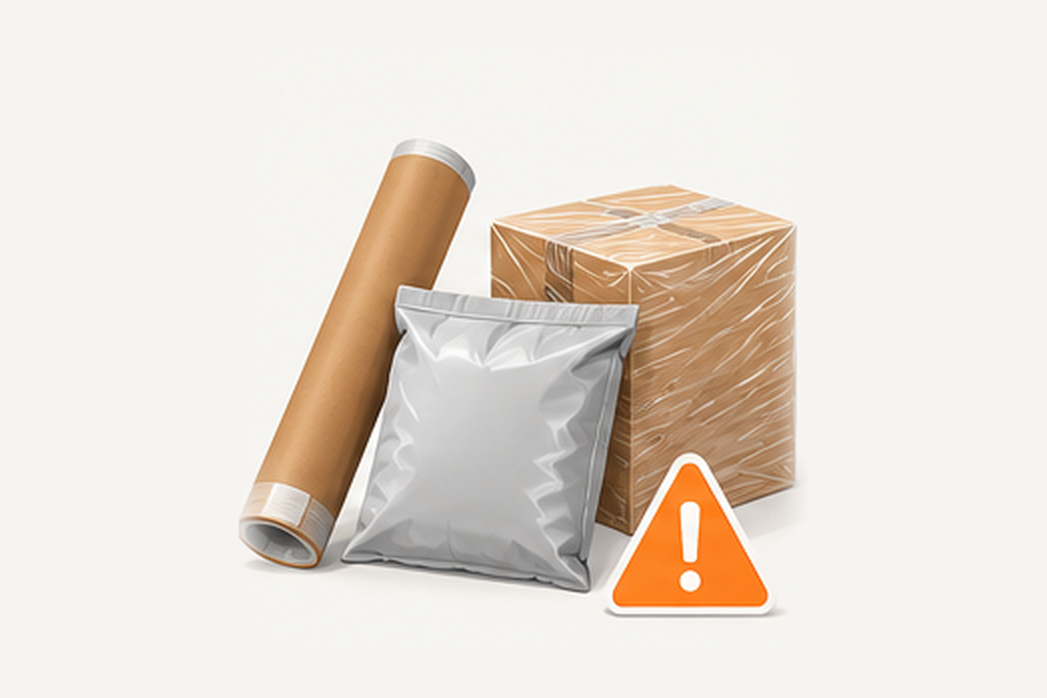
- is in an outer container covered in shrink wrap or stretch wrap;
- is in a soft-sided pack (courier packs, poly bags, bubble mailers) that exceeds 18 inches on its longest side, 13 inches on its second-longest side, or 5 inches in height (U.S. domestic shipments only);
- is round or cylindrical, including mailing tubes, cans, buckets, barrels, tires, drums or pails;
- is bound with metal, plastic or cloth banding, or has wheels, casters, handles or straps (a bicycle, for example), including packages that are loosely wrapped or where contents stick out; or
- could become entangled in or damage other packages or the FedEx sortation system.
The poly mailer rule
The soft-sided pack rule catches many apparel and soft-goods shippers. A poly mailer is fine as long as it stays within 18″ × 13″ × 5″. Overstuff it so it bulges past 5 inches, or use a larger bag, and every package picks up a $26.50–$33.75 surcharge.
2026 Rates by Zone
| Zone | FedEx 2026 |
|---|---|
| Zone 2 | $26.50 |
| Zones 3–4 | $30.75 |
| Zones 5–6 | $33.00 |
| Zones 7+ | $33.75 |
International package services pay a flat $29.50. UPS’s 2026 equivalent runs $26.75 to $33.75 by zone, so the two carriers are nearly identical at list. During peak season the Demand — Additional Handling Surcharge adds $8.80 to $11.85 per package.
FedEx also reserves the right to charge additional handling when a package needs special handling or when FedEx has to add packaging during transit, for example re-taping a carton that came apart.
How to Avoid the Packaging Surcharge
- Box it. Put tubes, buckets, cans and irregular items inside a corrugated box with filler. A box usually costs less than the surcharge.
- Size poly mailers correctly. Keep soft packs within 18″ × 13″ × 5″ and don’t overstuff.
- Skip the shrink wrap on single cartons. Wrapping a box in stretch film turns a standard package into a surcharged one.
- Remove or box handles, wheels and straps. Luggage, bikes and equipment cases ship cheaper in a carton.
- Find the source. Sort packaging surcharges by SKU and packing station. Most come from a handful of products or one station using the wrong materials.
Frequently Asked Questions
Why does my FedEx invoice say “Additional Handling” on a small package?
If the package wasn’t large or heavy, it was likely charged for non-standard packaging, such as a poly bag over 18 × 13 × 5 inches, a mailing tube, or shrink wrap. The invoice label is the same “Additional Handling” for every trigger.
Does FedEx charge extra for poly bags?
Only if the bag is larger than 18 inches by 13 inches or thicker than 5 inches, or if the contents aren’t fully enclosed. Within those limits, poly mailers ship without the packaging surcharge.
Does a mailing tube trigger the FedEx packaging surcharge?
Yes. Round or cylindrical packages, including mailing tubes, are listed as non-standard packaging.
How much is the FedEx packaging surcharge in 2026?
$26.50 to $33.75 per package by zone for U.S. package services, and $29.50 for international package services, plus fuel surcharge.
Does shrink wrap on a box trigger additional handling?
Yes. FedEx lists outer containers covered in shrink wrap or stretch wrap as non-standard packaging.
Related Reading
- FedEx Surcharges 2026: Every Fee, Rate & Threshold Explained
- FedEx Additional Handling – Dimensions 2026
- FedEx Additional Handling – Weight 2026
- FedEx Dimensional Weight 2026
- UPS Additional Handling – Packaging
Get a free carrier invoice audit
D’arrigo Consulting audits FedEx and UPS invoices line by line for surcharges that were billed when they shouldn’t have been. Request a free invoice audit to see what you can recover.
This article is for informational purposes only. Carrier rates, surcharges, and policies change frequently — always verify current terms directly with the carrier for your specific situation. Have questions? Reach out to us — we're happy to help.

Meet the Author
paul@darrigoconsulting.com
I’m Paul D’Arrigo. I’ve spent my career building, fixing, and scaling operations across eCommerce, fulfillment, logistics, and SaaS businesses, from early-stage companies to multi-million-dollar operators. I’ve been on both sides of growth: as a founder, an operator, and a fractional COO brought in when things get complex and execution starts to break

