October 29, 2026
USPS Dimensional Weight 2026: The New 139 Divisor Explained
2026 USPS rule: for Priority Mail Express, Priority Mail and USPS Ground Advantage parcels over 1 cubic foot (1,728 cubic inches), USPS charges the greater of actual weight or dimensional weight, calculated as L x W x H divided by 139, the same divisor UPS uses for daily rates.
Quick answer: Since July 12, 2026, USPS rounds each dimension up to the next whole inch, multiplies length by width by height, and divides by 139. Any fraction rounds up to the next pound. Dimensional weight only applies when the parcel is larger than 1 cubic foot. UPS applies its 139 divisor to packages of any size.
Rules: Domestic Mail Manual 283.1.4 (Ground Advantage commercial), 223.1.4 (Priority Mail commercial), 213.1.4 (Priority Mail Express commercial) and retail sections 133.1.4, 123.1.3 and 113.1.3. Divisor change effective July 12, 2026 per the USPS final rule published May 15, 2026. Prices: Notice 123, effective October 4, 2026.
What changed in July 2026
In its July 12, 2026 competitive products change, USPS revised the dimensional weight factor (divisor) and the rounding rule for retail and commercial Priority Mail Express, Priority Mail, USPS Ground Advantage and Parcel Select, “for consistency with industry standards” (Federal Register, May 15, 2026). Two things changed:
- The divisor is now 139.
- Length, width and height are now rounded up to the nearest whole inch before multiplying.
Both changes push dimensional weight up for the same box, so shippers with large, light parcels should re-check their USPS costs from July 12, 2026 on.
When USPS dimensional weight applies
| Product | Applies when | Divisor | DMM section |
|---|---|---|---|
| Priority Mail Express (retail and commercial) | Parcel exceeds 1 cubic foot (1,728 cu in), zones 1–9 | 139 | 113.1.3 / 213.1.4 |
| Priority Mail (retail and commercial) | Parcel exceeds 1 cubic foot (1,728 cu in), zones 1–9 | 139 | 123.1.3 / 223.1.4 |
| USPS Ground Advantage (retail and commercial) | Parcel exceeds 1 cubic foot (1,728 cu in), zones 1–9 | 139 | 133.1.4 / 283.1.4 |
A parcel that measures exactly 1,728 cubic inches or less is priced on actual weight. Commercial cubic pricing works differently: it prices pieces of up to 1 cubic foot by volume tier instead of weight, so dimensional weight does not apply to it.
How to calculate USPS dimensional weight
For a rectangular parcel, the DMM steps are:
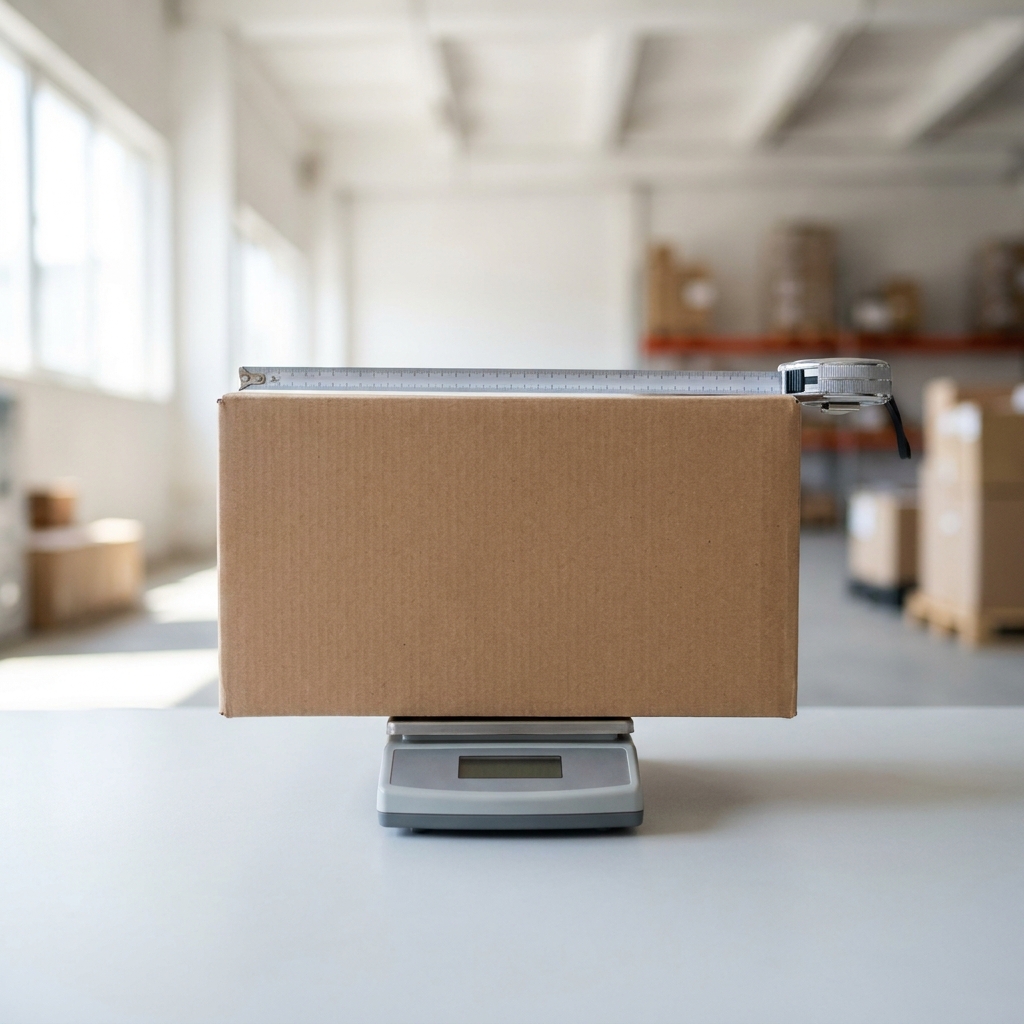
- Measure length, width and height in inches. Round each measurement up to the nearest whole inch.
- Multiply length x width x height.
- If the result exceeds 1,728 cubic inches, divide by 139 and round up to the next whole pound. That is the dimensional weight.
- Compare it with the actual weight. You pay the price for the greater of the two.
- If dimensional weight exceeds 70 lb, you pay the 70 lb price.
For a nonrectangular parcel, measure at the extreme points, round up, multiply, then multiply by an adjustment factor of 0.785 before testing against 1,728 cubic inches and dividing by 139.
Worked example
A product weighs 8 lb packed. Its carton measures 17.25 x 13.5 x 11.75 inches.
- Round up each side: 18 x 14 x 12 inches.
- Cubic size: 18 x 14 x 12 = 3,024 cubic inches. That exceeds 1,728, so dimensional weight applies.
- Dimensional weight: 3,024 / 139 = 21.76, rounded up to 22 lb.
- Billable weight: the greater of 8 lb actual and 22 lb dimensional = 22 lb.
| Service (commercial, zone 5) | Price at 8 lb | Price at 22 lb (billed) | Difference |
|---|---|---|---|
| USPS Ground Advantage | $16.54 | $31.20 | $14.66 |
| Priority Mail | $27.66 | $54.53 | $26.87 |
Prices from Notice 123, USPS Ground Advantage Commercial-Parcels and Priority Mail Commercial tables, effective October 4, 2026. These are time-limited prices that USPS has scheduled to end on January 17, 2027 (USPS, Aug. 25, 2026).
Now repack the same product in a 16 x 12 x 9 inch carton. That is exactly 1,728 cubic inches, which does not exceed 1 cubic foot, so the parcel is priced at its 8 lb actual weight. In this example the smaller box saves $14.66 on Ground Advantage and $26.87 on Priority Mail to zone 5.
The 18 x 14 x 12 carton does not trigger a nonstandard fee: no side is over 22 inches and 3,024 cubic inches is under the 3,456 cubic inch (2 cubic feet) threshold.
USPS vs UPS dimensional weight
| USPS (since July 12, 2026) | UPS (2026 daily rates) | |
|---|---|---|
| Divisor | 139 | 139 |
| Rounding of dimensions | Round up to the next whole inch | Round up to the next whole inch |
| Rounding of result | Up to the next whole pound | Up to the next whole pound |
| When it applies | Only parcels over 1 cubic foot (1,728 cu in) | May apply to all domestic and international package services |
UPS sources: UPS 2026 Rate and Service Guide, Daily Rates (January 26, 2026 edition), “Determine the Weight and Size.”
The divisor is now the same, so the difference is the threshold. A 12 x 12 x 12 inch box holding a 5 lb product is exactly 1,728 cubic inches. USPS prices it at 5 lb. UPS calculates 1,728 / 139 = 12.43, so it bills 13 lb. Once a parcel is larger than 1 cubic foot, both carriers arrive at the same billable weight for the same rounded dimensions. From there, base rates, surcharges and your contract decide which carrier is cheaper.
How to reduce USPS dimensional weight charges
- Find cartons just over 1,728 cubic inches. They gain the most from right-sizing, because getting under the threshold removes dimensional weight entirely.
- Measure the packed carton, not the product. USPS rounds every side up, so a 12.1 inch side counts as 13 inches.
- Use cubic pricing for small, dense parcels. Commercial Ground Advantage cubic accepts pieces up to 1 cubic foot, 20 lb and 22 inches on the longest side.
- Send accurate dimensions. Commercial shippers must report dimensions in the manifest. Missing or wrong dimensions can trigger the $3.00 Dimension Noncompliance Fee.
- Re-run carrier comparisons. Any USPS vs UPS comparison built before July 12, 2026 used the old USPS method.
Frequently Asked Questions
What is the USPS dimensional weight divisor in 2026?
139. USPS changed the divisor to 139 and began rounding dimensions up to the next whole inch on July 12, 2026, for Priority Mail Express, Priority Mail, USPS Ground Advantage and Parcel Select.
When does USPS charge dimensional weight?
When a Priority Mail Express, Priority Mail or USPS Ground Advantage parcel exceeds 1 cubic foot (1,728 cubic inches). USPS charges the greater of actual weight or dimensional weight.
How do I calculate USPS dimensional weight?
Round each side up to the next whole inch, multiply length x width x height, and if the result is over 1,728 cubic inches divide by 139 and round up to the next pound. For nonrectangular parcels, multiply by 0.785 first.
Does USPS Ground Advantage use dimensional weight?
Yes, at both retail and commercial prices, for parcels larger than 1 cubic foot. Commercial cubic-priced pieces, which are limited to 1 cubic foot, are priced by cubic tier instead.
Is USPS dimensional weight the same as UPS?
Both now use a 139 divisor and round dimensions up. The difference is that USPS applies dimensional weight only above 1 cubic foot, while UPS says dimensional weight may apply to all its package services.
Related Reading
- FedEx Dimensional Weight 2026: The 139 Divisor and How to Calculate It
- Why Dimensional Weight Is a Data Problem First
- UPS 2026 Rate Increase: Complete Guide to Every Service and Surcharge Change
- UPS vs USPS vs FedEx 2026: When to Use Each Carrier
- What Does UPS Additional Handling – Dimension Charge Mean?
Get a free shipping invoice audit
D’Arrigo Consulting finds the cartons and SKUs where dimensional weight is driving your parcel spend. Request a free invoice audit.
This article is for informational purposes only. Carrier rates, surcharges, and policies change frequently — always verify current terms directly with the carrier for your specific situation. Have questions? Reach out to us — we're happy to help.

Meet the Author
paul@darrigoconsulting.com
I’m Paul D’Arrigo. I’ve spent my career building, fixing, and scaling operations across eCommerce, fulfillment, logistics, and SaaS businesses, from early-stage companies to multi-million-dollar operators. I’ve been on both sides of growth: as a founder, an operator, and a fractional COO brought in when things get complex and execution starts to break