November 14, 2026
What Is Cross Docking? How It Works and When It Pays Off
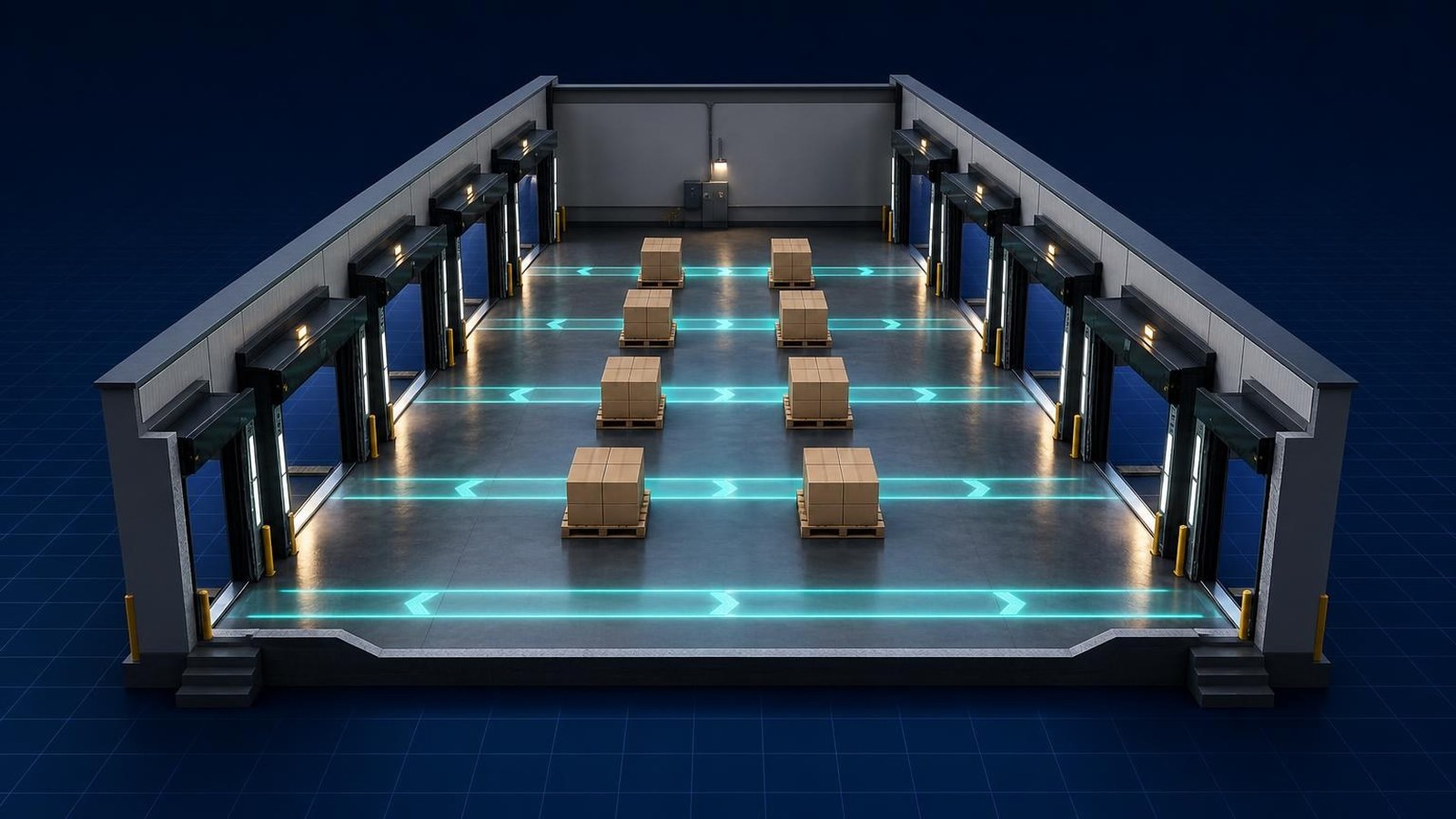
Cross docking means moving freight from an inbound truck straight to an outbound truck, with no put-away and no storage in between. The freight is in the building for hours, not days.
Quick answer: A normal warehouse receives, puts away, stores, picks and ships. A cross dock skips the three middle steps. Product comes off one trailer, gets sorted by destination in a staging area and goes onto another trailer. It works when you know where the freight is going before it arrives.
Source for the definition: Extensiv's logistics glossary, checked November 14, 2026.
How Cross Docking Works
- The supplier sends an advance ship notice, so the dock knows what is on the truck before it arrives.
- The truck is unloaded and the freight is checked against that notice.
- Each pallet or carton is sorted by where it is going next.
- Freight is staged at the outbound door for its destination.
- The outbound truck is loaded and leaves.
Nothing is put into a rack or a bin. If it is, even for a few hours, it has become ordinary warehousing.
Types of Cross Docking
| Type | What happens |
|---|---|
| Pre-distribution | The destination is assigned before the freight arrives. The supplier often labels each pallet or carton for the store or customer it is going to. |
| Post-distribution | The facility decides where each unit goes after it arrives, based on current orders. |
| Consolidation | Several small inbound shipments are combined into one outbound load. |
| Deconsolidation | One large inbound load is broken into smaller outbound shipments. |
Where You Already Use It
If you ship LTL, you already use cross docking. Your pallets move through the carrier's terminals, where they come off one truck and go onto another. See what LTL shipping is. Retail store replenishment and perishable goods run the same way, because the destination is known and time in storage adds cost without adding value.
Cross Docking vs Warehousing
| Warehouse | Cross dock | |
|---|---|---|
| Put-away | Yes | No |
| Time in the building | Days or weeks | Hours |
| Picking | Yes | No. Freight is sorted, not picked. |
| Buffer stock | Yes | No |
| Fits | Slow or unpredictable demand | Fast-moving freight with a known destination |
When It Pays Off, and When It Doesn't
Cross docking pays off when demand is known, volume is steady, inbound data is accurate and the product arrives already labeled or easy to sort.
It breaks down when demand is unpredictable or when advance ship notices are late or wrong. There is no buffer stock, so a late inbound truck means a missed outbound truck. If you are weighing it with a provider, see what a 3PL is, how to choose a 3PL and the shipping KPIs worth tracking.
Frequently Asked Questions
What is cross docking in simple terms?
Freight comes off an inbound truck, gets sorted and goes straight onto an outbound truck. It is never put away into storage.
What is the difference between cross docking and warehousing?
A warehouse puts freight away, stores it and picks it later. A cross dock skips put-away, storage and picking.
How long does freight stay at a cross dock?
Usually hours, not days.
Is LTL shipping a form of cross docking?
Yes. LTL freight moves through carrier terminals where it is transferred from one truck to another.
What does cross docking need to work?
Accurate advance ship notices, inbound trucks that arrive on schedule and a way to direct each pallet or carton to the right outbound door.
Related Reading
- What Is LTL Shipping? How LTL Freight Works, Freight Class and Rates (2026)
- What Is a 3PL? What Third-Party Logistics Providers Do and Charge
- What Is Pick and Pack? How It Works and What It Costs
- How to Choose a 3PL: Why the Lowest Bid Usually Costs You More
- Shipping KPIs: 5 Metrics That Actually Predict Cost Problems
- Standard Pallet Size: 48 x 40 Inches, and How Many Fit on a Truck
Need a second set of eyes on your operations?
D'Arrigo Consulting provides fractional COO services for e-commerce and logistics-heavy businesses. If your operation needs more attention than you have time to give it, get in touch.
This article is for general information only. Fees and practices vary by provider, and survey averages are not quotes. Have questions about operations? Reach out to us.

Meet the Author
paul@darrigoconsulting.com
I’m Paul D’Arrigo. I’ve spent my career building, fixing, and scaling operations across eCommerce, fulfillment, logistics, and SaaS businesses, from early-stage companies to multi-million-dollar operators. I’ve been on both sides of growth: as a founder, an operator, and a fractional COO brought in when things get complex and execution starts to break