.png)
.png)


January 22, 2026
Catching Inventory Integrity Issues Early


Introduction
Inventory inaccuracies are rarely discovered by spotting a missing item on the shelf. More often, they simmer unnoticed gradually eroding trust in your systems and squeezing margins before anyone raises an alarm. Waiting for stockouts or big cycle counts to expose problems means you're already in damage control mode.
Inventory integrity isn't about reacting to mistakes after they disrupt operations it's about catching the earliest signs before errors cascade. Traditional methods rely on lagging indicators: stockouts, large physical inventories, or customer complaints. But those signals come too late and are often costly to address.
Modern AI approaches offer a different path. By analyzing how inventory moves and behaves rather than just what's missing they identify subtle and emerging issues like cycle count drift, phantom stock, and mis-slots before these become operational burdens. This article breaks down how AI fits into a disciplined cycle counting and control framework, boosting inventory accuracy and building real operational resilience.
Understanding Inventory Integrity Issues
Cycle Count Drift
Cycle count drift occurs as small, compounding errors accumulate over time. A missed scan here, a misplaced return there, or an unrecorded short pick incrementally drives a wedge between the book inventory and actual physical stock. This gradual deviation may seem minor at first, but it undermines the reliability of the warehouse management system (WMS) data vital for planning, replenishment, and customer promises. If unaddressed, it erodes confidence, leaving managers hesitant and reactive.
Phantom Inventory
Phantom inventory describes stock quantities that appear available in records but do not exist on the warehouse floor. Causes include theft, damage left unreported, incorrect data entries, or misposted transactions. Phantom stock misleads replenishment logic, creates failed picks, inflates safety stock buffers, and ultimately drives operational inefficiencies. False availability signals damage customer service and increase carrying costs.
Mis-slots
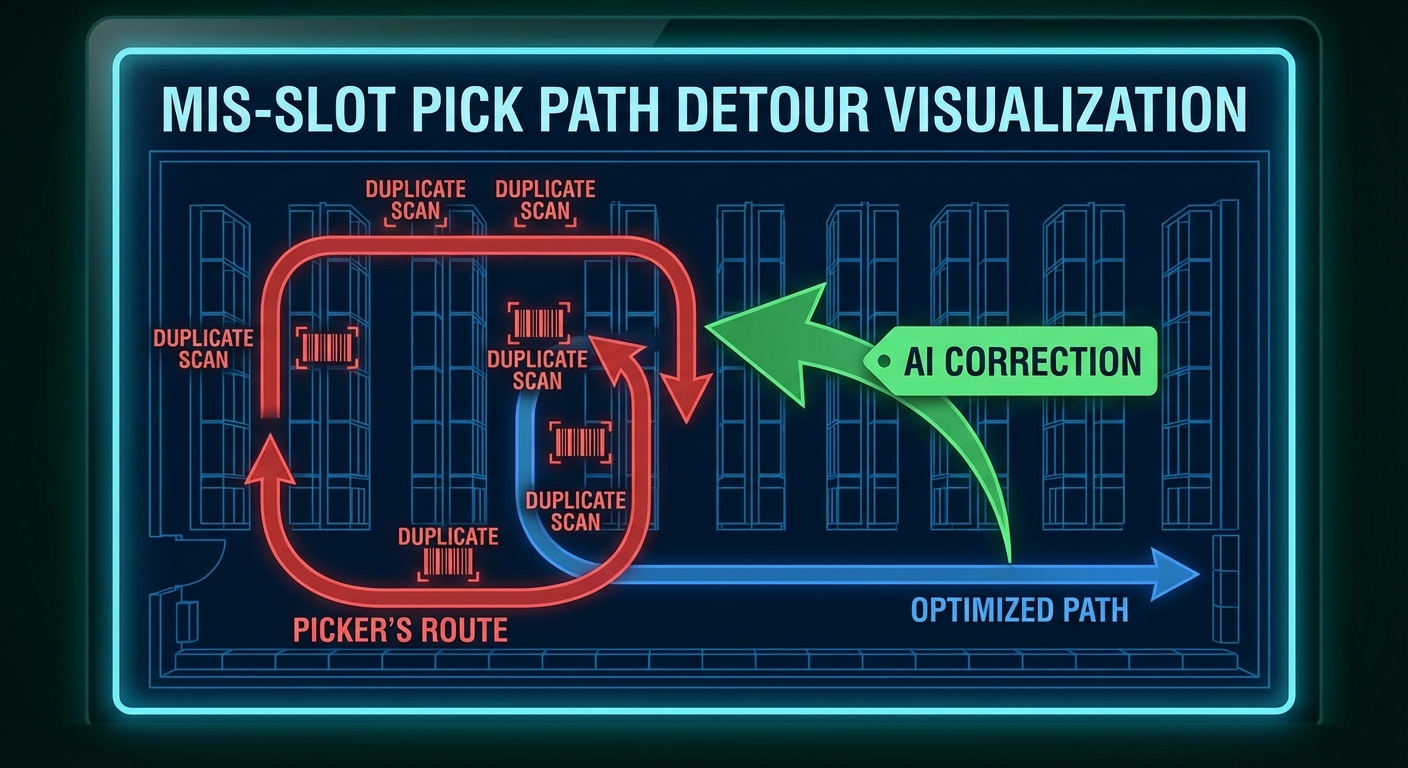
Mis-slots arise when items are physically placed in incorrect locations. This simple mistake cascades into search delays during picking, increased travel times, picking errors, and even chargebacks from customers due to mis-shipments. In a directed picking system, where location accuracy supports optimized labor and workflow, mis-slots disrupt assumptions around productivity and throughput.
Why These Issues Matter
Each of these integrity concerns directly impacts operational performance and financial metrics:
- Service levels suffer as accuracy below true availability results in stockouts or delayed shipments. Even a 98% accuracy rate can be misleading if errors cluster on high-velocity or critical SKUs.
- Carrying costs swell because inflated safety stocks and distorted consumption patterns drive unnecessary inventory investments.
- Operational drag rises as managers invest valuable time chasing discrepancies rather than focusing on improving overall warehouse flow.
- Control risks deepen when poor WMS trust encourages shadow spreadsheets, tribal knowledge, and manual overrides breeding further errors and internal control weaknesses.
Traditional Detection Methods and Their Limitations
How Problems Typically Surface
Conventional approaches to catching inventory issues depend heavily on lagging indicators, triggered only when problems become large enough to disrupt operations:
- Stockouts or failed picks spur emergency recounts or investigations.
- Quarterly or annual physical inventories uncover large variances.
- Customer complaints and chargebacks highlight mis-picks or shipment errors.
- Finance reconciliations note shrink or inventory adjustments during period closes.
Why This Is Late and Costly
Detecting inventory integrity problems through these signals is inherently reactive and expensive:
- Lagging signals mean that by the time discrepancies emerge, root causes are often weeks old and obscured by operational noise.
- Large-scale, manual cycle counts pull labor away from productive work, causing disruptions.
- Reconciliation adjusts records but usually fails to tackle underlying process flaws without root cause analysis and sustained follow-up, the same errors recur.
- Control gaps remain unaddressed when segregation of duties, approvals, and documentation are weak or lacking. The Government Accountability Office (GAO) Green Book makes clear that effective internal controls require ongoing monitoring, risk assessment, and controls episodic fixes are inadequate.
How AI Detects Inventory Integrity Problems Early
AI brings a fundamentally different capability to inventory management by analyzing behavioral patterns not just waiting for what's missing to detect early signs of integrity issues.
Behavioral Pattern Analysis
Instead of reactive counting, AI continuously monitors the flow of operational data—picks, putaways, inventory moves, cycle count variances, scan activity, replenishments, license plate numbers, and slot usage. Embedded machine learning models detect anomalies and shifting behaviors that signal a divergence between physical reality and book records.
Specific examples include:
- Drift Detection by ABC Classification: AI tracks count variances over time, segmented by SKU class and storage location. Persistent negative or positive trends trigger risk-based adjustments in count frequency. For example, an A-class SKU with recurring -1 discrepancies will get prioritized for more frequent blind counting, focusing attention where it offers the highest return on effort.
- Phantom Inventory via Activity Mismatch: When the system reports stock at a location but there is little to no picking, scanning, or replenishment activity, AI flags this as "cold inventory." Additional signals, such as unexplained negative adjustments or damaged goods counts, confirm potential phantom issues requiring recounts or investigations.
- Mis-slot Indicators: By analyzing pick path deviations, duplicated SKU scans across multiple bays, or increased "location not found" errors, AI models uncover signs of item misplacement. This behavioral insight allows targeted slot audits and corrective moves before errors ripple into customer orders.
- Shrink and Substitution Patterns: Repeated short-picks on particular SKUs, combined with unusual replenishment activity or damage reports, reveal phantom inventory or substitution risks. Early alerts prompt process checks or recounts before operational impact escalates.
Concrete Examples
- A skewed item consistently records a weekly -0.3% to -0.5% negative variance. The AI system dynamically escalates count frequency for that SKU, quarantines recent receipts for recounting, and recommends a receiving audit that uncovers incorrect packaging units on inbound shipments. By catching this early, the team corrects receiving processes before customer orders face stockouts.
- A C-class SKU shows 48 units in a remote rack location yet no scan or picking activity for over three months. AI flags a phantom risk; a recount confirms zero stock. The root cause was an unposted return transaction causing ledger inflation. Fixing this reduces unnecessary safety stock and improves demand signals.
- Pickers repeatedly backtrack to locate the same SKU in an aisle, and AI detects route anomalies with multiple scans across adjacent bays. Investigation reveals a mis-slot; correcting the item's location streamlines picking and eliminates errors.
Why This Works
Early detection allows operations to zoom in on small, local problems rather than mounting large-scale interventions after escalation. Exception-driven recounts and focused audits reduce labor costs and disruption. Importantly, resolved variances continuously feed back into AI models, improving detection capabilities over time.
Supporting Systems and Process Controls That Amplify AI's Impact
AI is an amplifier of visibility and intelligence not a silver bullet. Solid foundational controls and disciplined processes are essential to translate AI insights into lasting improvement.
Closed-Loop Cycle Counting
- ABC and risk-based counting programs are critical. Scheduling cycle counts dynamically by SKU velocity, value, or risk focuses effort where it matters most. This approach, recommended by APICS and ASCM, replaces inefficient blanket inventory counts with targeted verification (apicssanantonio.starchapter.com).
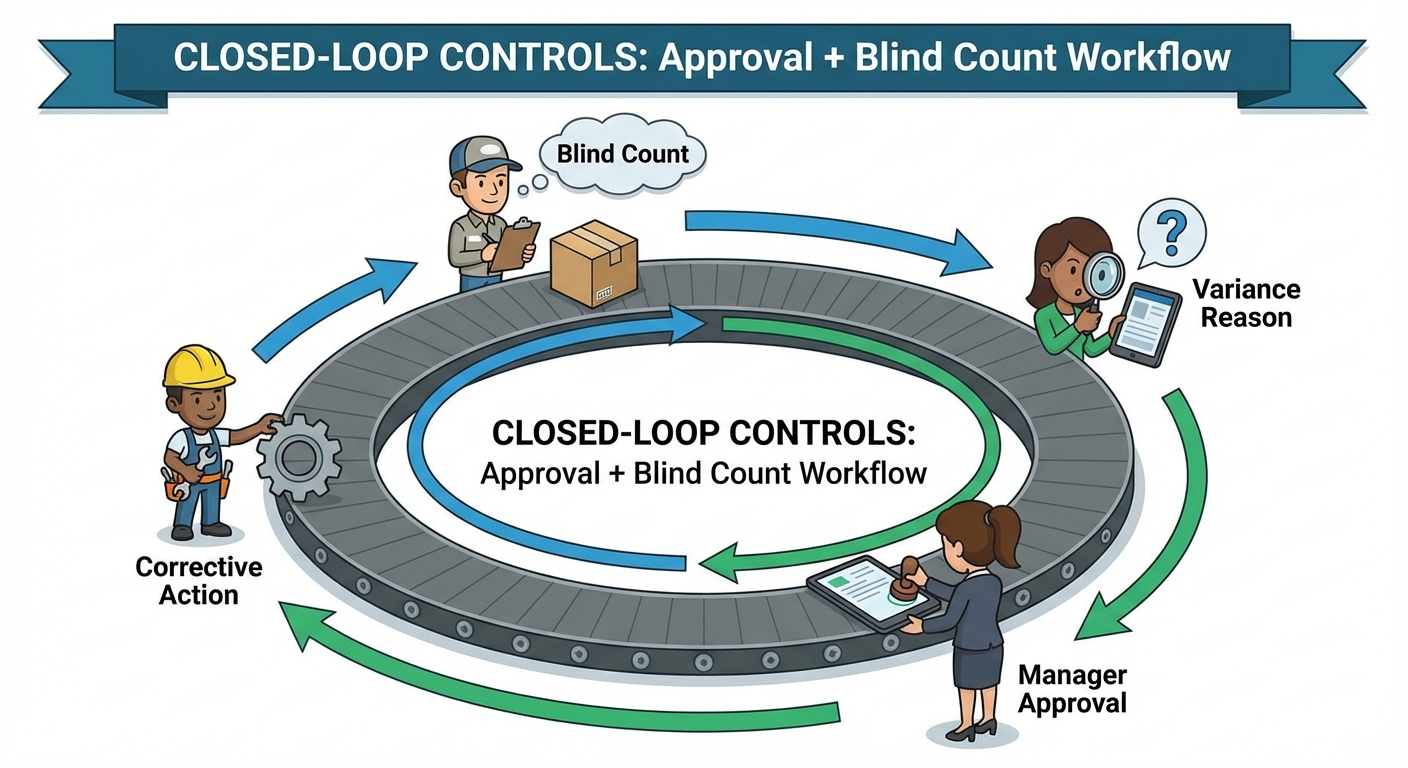
- Blind counts, where counters do not see book quantities, coupled with segregation of duties (counters distinct from approvers), mitigate bias and fraud. This aligns with GAO Green Book internal control standards (gao.gov).
- Immediate variance research incorporating reason codes captures root causes such as receiving errors, short picks, or damage, enabling focused corrective action and reducing repeat errors.
Real-Time Visibility and Escalation
- Dashboards presenting inventory accuracy percentages, count pass rates, variance reasons, and exceptional conditions (e.g., cold inventory locations, pick exceptions) provide operators with actionable intelligence. ASCM KPI guidance encourages such monitoring as a cornerstone of efficient warehouse operations (ascm.org).
- Automation triggers exception-driven recounts and workflows that require managerial approvals before any adjustments finalize in the WMS. This ensures process discipline and auditability; Oracle WMS cycle count controls demonstrate these capabilities (docs.oracle.com).
Technology Enablers
- Barcoding, radio frequency (RF) scanning, and mobile workflows are table stakes for capturing reliable digital records at every physical touchpoint.
- Where justifiable, radio frequency identification (RFID) provides automatic, non-line-of-sight tracking, improving shrink detection and location accuracy. GS1 offers practical guidance for RFID implementations in inventory management (supplychain.gs1us.org).
- Maintaining clean master data including units of measure, pack sizes, and accurate location descriptions is foundational. Data errors account for many false positives and wasteful investigations.
Operational Discipline
- Standardized work must mandate that every inventory variance concludes with not just a count adjustment but process or control fixes addressing root causes.
- Training and incentive programs aligned on inventory accuracy and issue closure (rather than throughput alone) help embed a culture of ownership and precision at all levels.
Practical Implications for Scaling Operations
As operations scale in order volume, SKU complexity, labor diversity, and network nodes, manual and traditional controls fray. Risk exposure increases exponentially.
Why Early Detection Matters at Scale
- Frequent, small course corrections maintain integrity and prevent costly, disruptive overhauls triggered by accumulated errors.
- Targeted recounts and root cause resolution are more cost-effective than blanket inventories and emergency responses.
- Reliable inventory data supports leaner buffers, more accurate planning, and tighter customer promises.
Implementation Considerations
- Prioritize foundational data cleanliness, robust scanning compliance, and comprehensive, consistently applied reason codes.
- Integrate WMS transactional data, scan streams, count results, and variance workflows into a unified analytical platform capable of behavioral pattern detection.
- Develop clear escalation procedures defining responsibilities and timing for intervention, resolution, and reporting.
Tradeoffs to Recognize
- Initial investments in AI platforms, system integration, and training can be significant. RFID investments, in particular, must be justified by shrink risk or operational complexity.
- Early AI deployments typically generate noise requiring model tuning and data cleanup to improve signal-to-noise ratios.
- Changing culture from firefighting lagging events to disciplined, proactive control can slow initial throughput but fosters stronger long-term stability and cost efficiency.
A Practical Operating Model
Inputs
- WMS transaction histories, RF scan data streams, cycle count results annotated with reason codes, replenishment and picking exception records, returns, and damage reports.
Models
- Drift trend analysis by SKU and location, scan activity mismatches identification, route deviation detection, and shrink or substitution pattern recognition.
Triggers and Actions
- A-class SKU accuracy below 98% prompts blind recounts.
- Two failed picks within 48 hours at a location trigger recount and quarantine of that bay.
- Lack of scan activity for two weeks on inventory flagged as at risk initiates phantom inventory investigations.
- Repeated unit-of-measure (UOM)-related adjustments launch receiving audits.
Actions include targeted blind cycle counts, requiring managerial approvals before adjustments post, applying process fixes upstream, and recalibrating count frequencies. Solutions integrate continuous improvement by adjusting model thresholds based on resolved variances.
Day-to-Day Example
Morning stand-up meetings incorporate a quick dashboard review:
- Location B-14 flagged for phantom risk due to stock on hand with no recent activity. A recount confirms zero units; further investigation finds unposted damage write-offs. Ledger corrected, dock and receiving teams retrained to prevent recurrence.
- SKU X exhibits a weekly -0.6% negative variance over several weeks. Count frequency rose accordingly; a receiving audit found an errors in unit pack size data on supplier data sheets—corrected and shared with procurement.
- Route anomalies in aisle 7 highlight SKU Y repeatedly picked at the wrong bay. Slot reassignment follows recount and confirmation, streamlining picks and improving travel time metrics.
Each resolution consumes minutes, preventing stockouts, expedited shipping fees, or weekend-count disruptions.
Operator's Note
Experience leading fulfillment and logistics teams demonstrates that the biggest improvement doesn't come from "more counts." It comes from shifting focus from chasing lagging symptoms like stockouts to monitoring leading behavioral signals of inventory health. The core discipline—blind counts, segregation of duties, managerial approvals—remains. But with these behaviors visible, teams catch small deviations early rather than fighting predictable, multi-alarm fires later.
Where to Start If You're Building This Now
- Establish fundamentals: enforce barcoding or RF scanning on all critical inventory touches, maintain clean master data, and implement a closed-loop cycle counting program with ABC-based frequencies and comprehensive reason codes.
- Build dashboards to monitor inventory accuracy by classification, net adjustments by reason, count pass rates, and exception trends.
- Add automation features that auto-generate recounts for threshold breaches, implement behavioral scoring models for drift and mismatch detection, and pilot RFID technology where operationally justified.
- Embed approval and accountability workflows, including supervisor signoff before inventory adjustments post, and link repeated variance patterns to process audits and refresher training programs.
References and Resources
- GAO Green Book on Internal Controls
- APICS San Antonio on Cycle Counting Best Practices
- ASCM Warehouse KPIs
- GS1 RFID Basics
- Oracle WMS Cycle Count Controls
Conclusion: What to Expect Moving Forward
Early AI detection is not a silver bullet. Rather, it is a practical tool to strengthen foundational controls, reduce costly interventions, and improve operational resilience in inventory management. Its success depends on:
- Solid and disciplined processes coupled with clean, reliable data. Without these, AI surfaces problems but cannot resolve them.
- Aligning incentives so teams value and own inventory accuracy alongside throughput and efficiency.
- Embracing evolution, not revolution — start with dashboards and exception monitoring, then integrate advanced behavioral analytics as data maturity improves.
The result is a warehouse you can trust, driven by steady, small adjustments informed by actual inventory behaviors rather than firefighting surprises only visible after disruption occurs.
Related Reading
- Turning Messy Operational Data into Decisions with AI
- Forecasting Labor Shortfalls and Overtime Risk
- The Hidden Cost of Tribal Knowledge — and How AI Captures It
- Modern AI on Top of Old WMS Software
This article is for informational purposes only. Carrier rates, surcharges, and policies change frequently — always verify current terms directly with the carrier for your specific situation. Have questions? Reach out to us — we're happy to help.

Meet the Author
paul@darrigoconsulting.com
I’m Paul D’Arrigo. I’ve spent my career building, fixing, and scaling operations across eCommerce, fulfillment, logistics, and SaaS businesses, from early-stage companies to multi-million-dollar operators. I’ve been on both sides of growth: as a founder, an operator, and a fractional COO brought in when things get complex and execution starts to break

