.png)
.png)


January 22, 2026
Why Shipping Costs Spike Right After You Fix Them

Why Shipping Costs Spike Right After You Fix Them
Shipping costs don’t stay “fixed” for long because the market is designed to reprice capacity fast. Here’s how blank sailings, General Rate Increases (GRIs), and seasonal pressures unwind quick wins—and how to build a portfolio and processes that hold up over time.
I. Introduction: A Real-World Observation
Why do shipping costs surge again right after you finally get them under control?
It’s a question anyone managing logistics has wrestled with: you negotiate, you lock in contracts, you curb surcharges—and yet, just when it seems stable, rates spike unexpectedly. This isn’t about poor negotiating skills or bad timing. It’s how the shipping market’s structure and incentives actually work.
In this article, I’ll walk through the operational reality behind these cost swings. Understanding the market’s built-in volatility and the limits of common “quick fix” tactics is key to building a shipping cost management approach that lasts. This isn’t a sales pitch or a magic bullet—it’s about systems thinking, real-world constraints, and practical strategies that align with how carriers and markets behave.
II. The Shipping Market’s Built-In Volatility
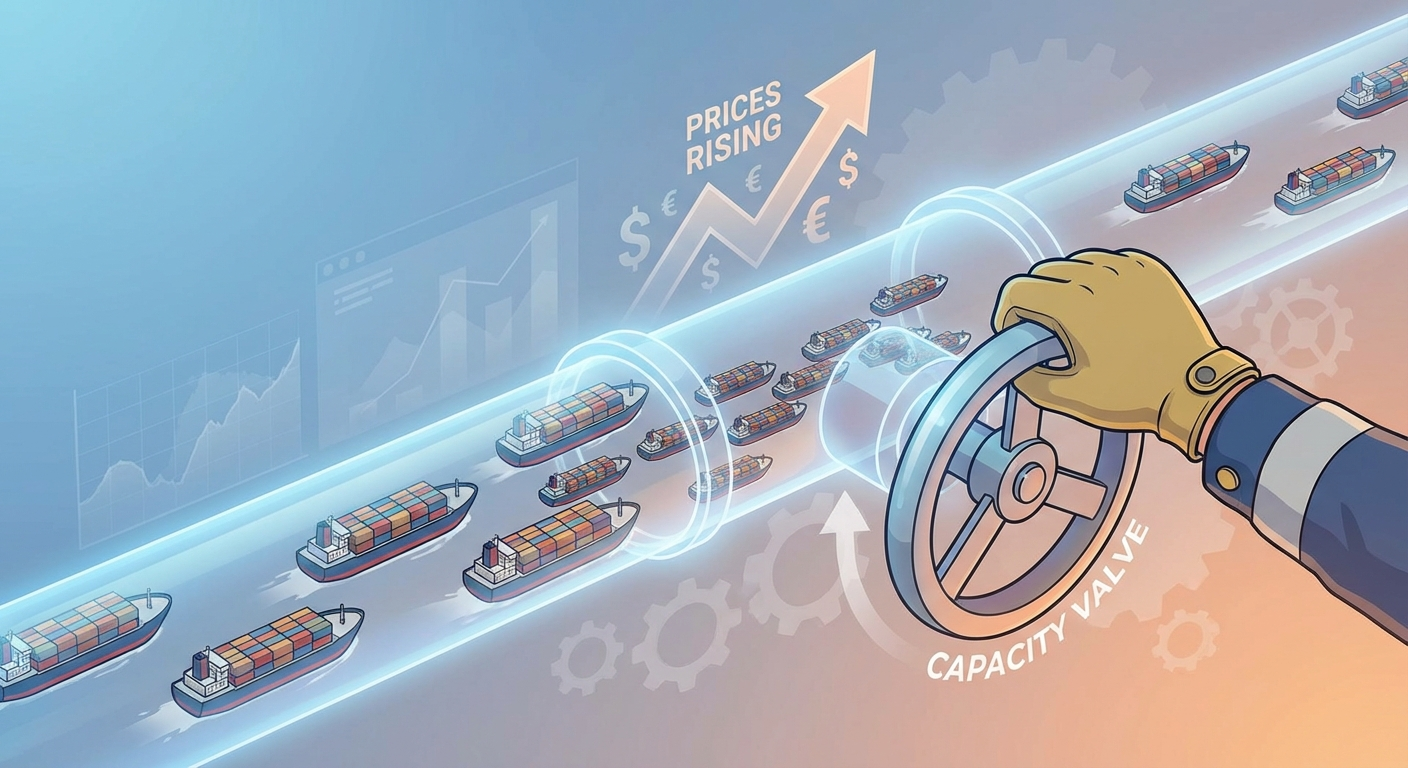
Ocean and parcel markets are structured to reprice quickly. Carriers manage capacity like a valve. Shippers experience that as volatility.
Here are the structural drivers that cause costs to jump right after you “fix” them:
- Capacity withdrawal: Ocean carriers regularly remove strings of sailings (“blank sailings”) to tighten supply when demand softens. Cut capacity, lift utilization, and then prices move. This is not speculation; it’s a standard tool documented across recent rate cycles and covered widely by market analysts and trade press. For example, see reports on blank sailings and how carriers use them to support pricing when demand wobbles.
- General Rate Increases (GRIs): Carriers can file GRIs across lanes with short notice. Even with good base rates negotiated, a GRI can reclaim a meaningful percentage of savings in a single filing. GRIs often land in clusters, especially when multiple carriers move in coordination.
- Seasonal peaks and fuel surcharges: Peak season surcharges, equipment imbalances, and bunker/fuel cost adjustments layer on top of base rates. The timing tends to be predictable, but the magnitude is not. Fuel adjustments often lag and then overcorrect; peak surcharges can appear rapidly when capacity tightens.
- Market sentiment and geopolitical factors: Rates are influenced not only by math but by expectations. When carriers and forwarders anticipate a tight third quarter, they pre-position capacity and pricing signals accordingly. Geopolitical disruptions cause congestion that ripples through trades. Even without a direct impact to your lanes, sentiment can elevate the market floor.
- The index reality: Tracking published benchmarks such as Drewry’s World Container Index reveals step changes around peak windows, disruptions, or coordinated capacity moves. These step changes explain why short-term cost wins often evaporate quickly.
Put simply: carriers operate supply dynamically. When demand, sentiment, or cost inputs shift, carriers act fast. The market structure makes rate resets more rapid than most shippers can renegotiate contracts.
III. Why Quick Fixes Don’t Stick: The Limits of Traditional Tactics
When costs escalate, teams often reach for fast remedies. I’ve been in those rooms. As COO at a supply chain consultancy focused on parcel and freight optimization, I frequently observed quick gains followed by snap-backs. The reason isn’t lack of effort—it’s a misalignment between tactic and system.
Common quick fixes and their limitations:
- Spot bidding your way out: Spot wins are visible and immediate but most exposed to the next market development. When carriers tighten capacity or file a GRI, your spot “fix” resets overnight. In rising markets, spot rapidly becomes a tax.
- One-off contract renegotiations: You grind down base rates, but carriers respond by applying GRIs, widening surcharge bands, or tweaking accessorial definitions. Gains get diluted across multiple line items. Without contract language that governs these levers—like caps, escalators, floors, or ceilings—you’re playing whack-a-mole.
- Reactive fuel surcharge caps: Fuel surcharges often attract negotiation, but caps without clear indexing or structured adjustment schedules can backfire. If caps reset frequently or tie to narrow benchmarks, you might pay more during volatile periods while thinking you’re protected.
- Overconcentration: Consolidating volume to chase tiered pricing helps in stable periods but concentrates risk. If your primary carrier pulls capacity or reprices, your leverage diminishes drastically.
- Fixing freight in isolation: Freight costs are a downstream result of product mix, inventory posture, lead times, and customer promises. Without adjusting those upstream levers, the freight team fights volatility with one hand tied.
Carriers are rational actors. Facing widespread spot defection or aggressive renegotiation, they use tools like capacity adjustments and GRIs to protect yield. A purely tactical approach invites tactical responses.
IV. A Systems Approach to Managing Shipping Costs
Accepting built-in volatility means shifting your objective from “beat the market” to “shape exposure.” It’s portfolio management—blending instruments, diversifying counterparties, and using data to time decisions.
Core elements include:
- Mix contract types:
- Use fixed contracts for a portion of baseline demand in lanes where you value stability and can forecast volume credibly.
- Use index-linked agreements for lanes with high volatility or low transparency. These tie rates to published indices with formulas, reducing friction and keeping you near “fair value” without constant renegotiations.
- Keep spot exposure bounded for overflow or opportunistic buys, treating spot as a release valve rather than a core strategy.
- Build floors, ceilings, and caps:
- In indexed contracts, negotiate floors to protect carriers in downcycles and ceilings to shield you from spikes.
- Cap volatile surcharges explicitly, defining the index, timing, and adjustment methods. Avoid ambiguity, which invites creeping costs.
- Diversify carriers, lanes, and modes:
- Split awarded volumes across at least two carriers per major lane when feasible to maintain optionality if capacity is withdrawn or rates reprice.
- Maintain realistic modal alternatives. If transit promises allow, intermodal or slower services absorb shocks when premiums spike.
- Forecast early and reserve capacity:
- Peak seasons shouldn’t be surprises. Share forecasts months ahead and pay for capacity reservations where delays are unacceptable—it’s cheaper than in-season premiums.
- Time tenders with market data:
- Monitor benchmarks like Drewry’s World Container Index and carrier advisories. Avoid locking long if indices roll over; secure coverage when rates trend upward but stability is needed.
- Track blank sailing announcements and equipment availability to be proactive. Services providing market intelligence help here.
The goal isn’t to outguess the market but to decide, lane by lane, how much volatility to accept and what to pay to hedge it.
V. Operational Best Practices to Sustain Cost Control
Strategy sets exposure; operations keep gains.
- Audit every invoice monthly:
- Surcharge creep is real—terminal handling, documentation, chassis fees, demurrage/detention definitions. Small errors compound. Build automated checks against contracts and historical data.
- Close the loop with carriers quickly. Long aging kills recovery chances.
- Lock definitions, not just numbers:
- Clearly define accessorial triggers and required documentation in contracts. Ambiguous language costs money.
- Scenario planning:
- Model “what-if” scenarios for +25% fuel hikes, -10% capacity shifts, or multiple GRIs over months. Identify broken lanes, movable orders, and adaptable promises. This forms a playbook for rapid response.
- Align internal knobs:
- Freight is downstream of merchandising and sales. Coordinate order minimums, cutoffs, and pack configurations that reduce air volume and dimensional weight. For parcel contracts, consider re-rating products and packaging.
- Collaborate with carriers:
- Share forecasts, promotional calendars, and reward balanced performance. Adversarial posturing feels good short-term but risks allocation and premium costs later.
- Where possible, pilot technology and process improvements jointly—appointment APIs, EDI cleanup, dock scheduling. Operational friction acts as pricing power; reduce it.
- Establish decision thresholds:
- Pre-approve rules like “if GRI > X on lane Y, shift Z% volume to indexed carrier” or “if bunker index exceeds A for two weeks, trigger fuel re-opener.” Predefined actions cut reaction time and dampen emotional decisions.
VI. How Volatility Shows Up—and What to Do When It Does
Consider the Transpacific lane example: you fix costs with new annual contracts in May. In June, carriers announce blank sailings for July and August plus a GRI. Drewry’s index ticks upward. Your base rate remains, but GRIs land, fuel adjusts, and space tightens. To keep schedule integrity, you pay premiums. Six weeks after your contract signing, your savings erode.

What would help hold more gains?
- A split award: 60% fixed contract, 30% indexed contract with a ceiling, and 10% spot exposure for overflow.
- Clauses capping GRIs or tying them to rolling averages of published indices, with defined lag and ceiling.
- Early July capacity reservations on priority sailings for high-margin SKUs to avoid last-minute premiums.
- Predefined triggers to shift promotional volume to slower modes or move inventory forward when indices breach thresholds.
None of these eliminate spikes but make them predictable and bounded.
VII. Why This Keeps Happening—and What Might Change
Cost spikes after fixes aren’t due to willpower failures but structural and incentive realities:
- Carriers must fill vessels at target yields; capacity tools and GRIs maintain this.
- Shippers are fragmented; coordinated carrier actions have more leverage than fragmented buyer reactions.
- Information asymmetry favors those who see demand and capacity signals first—typically carriers and some data providers.
Potential shifts include:
- Broader transparency and adoption of index-linked contracts to decrease renegotiation friction and whipsawing. These won’t remove volatility but better align incentives.
- Improved forecasting and earlier capacity commitments by shippers to reduce last-minute premiums.
- Technology advances that reduce operational friction—cleaner EDI, better scheduling, standardized accessorial definitions—will reduce “hidden taxes” when networks are stressed.
What likely won’t change is the fundamental dynamic—carriers will keep managing capacity and prices to market conditions, seasonal peaks, geopolitical events, and fuel prices will continue to cause variability. The task remains managing exposure and closing leakages.
VIII. Sidebar: A Quick Guide to Index-Linked Freight Contracts
Index-linked agreements tie your rate to a published benchmark with a formula that can include floors and ceilings. Done well, they:
- Reduce renegotiation frequency by allowing rates to float within defined bands.
- Keep both parties near “fair value” through market cycles.
- Provide clarity on when and how rates move.
Key components to negotiate:
- Benchmark index (for example, lane-level indices from trusted providers).
- Update frequency (weekly, biweekly, monthly).
- Floors and ceilings to balance risk.
- Treatment of surcharges—whether bundled or separate, and how adjustments work.
- Volume commitments and service guarantees.

Conclusion
Shipping costs spike after you “fix” them because the market is designed to reprice capacity quickly. Carriers pull sailings, file GRIs, and reset surcharges faster than most organizations can renegotiate. Seasonal demand and fuel prices add pressure. Sentiment and disruption amplify volatility.
You can’t negotiate volatility out of the system. But you can decide how much of it to hold—and where. Treat procurement like a portfolio: blend fixed, indexed, and spot contracts; cap and define surcharges; diversify carriers and modes; forecast early and reserve capacity; audit relentlessly; and use market intelligence to time tenders and trigger moves.
This isn’t a magic bullet, but a disciplined way to keep more of your savings and avoid surprises. With alignment, clear incentives, and cleaner operations, the spikes won’t disappear—they’ll just hurt less, and your business will be built to handle them.
Disclaimer
The information provided in this article is for informational purposes only and reflects the author’s experience and insights as of the date of publication. It does not constitute legal, financial, or contractual advice. Readers should consult appropriate professionals for advice tailored to their specific circumstances. The author and publisher disclaim any liability arising from the use of this material.


Meet the Author
paul@darrigoconsulting.com
I’m Paul D’Arrigo. I’ve spent my career building, fixing, and scaling operations across eCommerce, fulfillment, logistics, and SaaS businesses, from early-stage companies to multi-million-dollar operators. I’ve been on both sides of growth: as a founder, an operator, and a fractional COO brought in when things get complex and execution starts to break