.png)
.png)


January 22, 2026
Why Prohibited Item Fees Are Designed to Be Punitive

Why Prohibited Item Fees Are Designed to Be Punitive
Prohibited item fees aren’t arbitrary charges. They are intentionally designed to deter risky behavior and recover the real, unplanned costs carriers face when shippers send banned, hazardous, or non-compliant goods. This article explains how the system works, why fees are deliberately steep, and under what conditions they might soften in the future.
Introduction
Prohibited item fees are one of those unavoidable line items on shipping invoices that frustrate many shippers. The immediate reaction is to see them as arbitrary penalties—added costs that feel unfair or punitive for something that seems avoidable. But the reality is more nuanced. These fees are not just a revenue play; they are an intentional, structural feature built into carrier operations to manage very real risks, costs, and regulatory constraints.
This article takes a close, grounded look at why prohibited item fees exist at the levels they do. We’ll walk through the operational realities carriers face when handling these shipments—how safety concerns, unplanned costs, and legal obligations shape pricing strategies. By unpacking the incentives behind these fees, this piece aims to clarify why they are designed to be — and must remain — significant enough to change behavior and keep complex logistics systems running safely and efficiently.
1. What Counts as a Prohibited Item — and Why It Matters
“Prohibited” is a broad term. Depending on the carrier and transport mode (air versus ground), it includes:
- Items banned outright by the carrier
- Hazardous materials requiring specific packaging or labeling but shipped undeclared
- Legally restricted items for certain routes, quantities, or packaging (e.g., lithium batteries, aerosols, alcohol, chemicals)
- Goods violating import/export or postal regulations
The unifying factor across all these categories is risk. A small aerosol can in a tightly packed trailer doesn’t just pose theoretical danger—it is pressure and temperature sensitive. An undeclared lithium battery in a padded envelope introduces thermal runaway risks that can ground flights or prompt emergency evacuations. Mislabeled chemicals can damage other packages or harm workers.
Carriers operate under strict regulatory frameworks such as the U.S. Department of Transportation’s Pipeline and Hazardous Materials Safety Administration (DOT/PHMSA), the International Air Transport Association’s Dangerous Goods Regulations (IATA DGR) for air shipments, and the United States Postal Service’s rules for mail. USPS, for instance, outlines civil penalties, cleanup expenses, and even criminal consequences for unsafe mailings in Publication 52. Carrier policies align with these legal obligations and public safety priorities; these rules do not exist in isolation. They serve a public and operational safety role, protecting millions of workers and customers involved in logistics operations daily.

2. The Unplanned Costs When a Prohibited Item Appears
Discovering a prohibited or undeclared hazardous package triggers a costly chain of events that carriers and their operators rarely anticipate in budgeting:
- Inspection and Identification: Once a package is flagged or intercepted, staff must stop conveyor belts or scanning lanes to physically examine and identify the item. This disrupts workflow, delays downstream sorting, and requires labor hours that are often overtime or specialist time.
- Isolation and Containment: If a package is leaking liquids, vapors, or is otherwise hazardous, workers must isolate the package and the affected area. This can involve evacuations of personnel from sort rooms, temporary shutdowns of sorting equipment, and relocation of nearby shipments.
- Special Handling and Equipment: Hazmat-certified operators and personal protective equipment (PPE) must be employed to safely handle or move the prohibited material. External contractors might be called in for chemical testing, cleanup, or environmental remediation.
- Repacking or Redirecting: Salvageable shipments repacked and redirected incur additional packaging material costs and logistics labor. Items that cannot be salvaged are disposed of following hazardous waste protocols.
- Cleanup and Disposal: Materials such as spill kits, ventilation equipment, licensed hazardous waste removal, and decontamination efforts rack up substantial expenses.
- Documentation and Reporting: Regulatory agencies often require detailed incident reports, chain-of-custody records, photographs, and sometimes even law enforcement involvement, all adding administrative overhead.
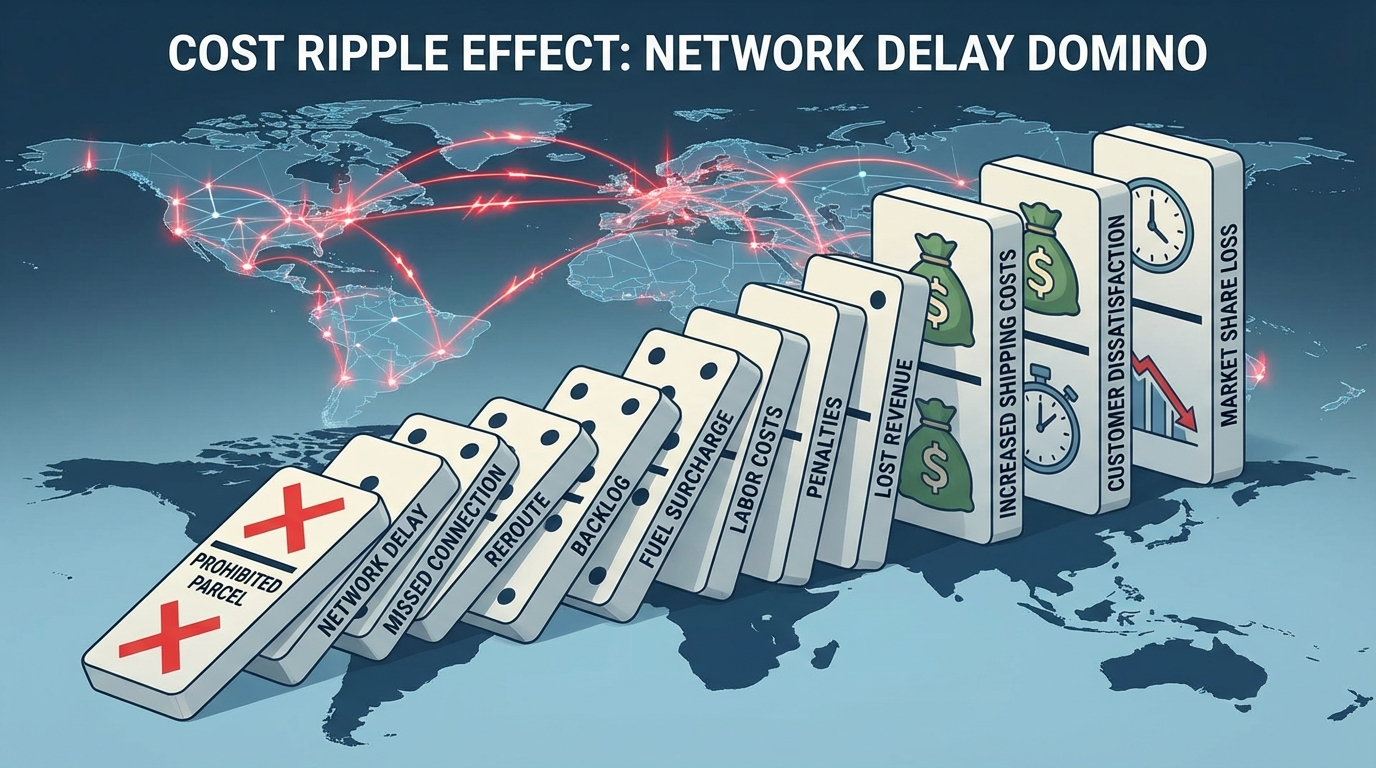
- Ripple Effects in Operational Flow: Delays cascade through the network—delayed flights, postponed ground deliveries, and strained customer commitments increase indirect costs.
Carrier policies from UPS and FedEx explicitly state that prohibited item fees are intended to recover these real, direct costs. FedEx describes their Non-Compliant Materials Reimbursement as a way to offset labor and material costs incurred from improperly shipped hazardous or prohibited goods. Similarly, UPS clarifies that these fees are not fines but cost recovery measures necessary to sustain safe and effective service. These unplanned events disrupt the finely tuned choreography of parcel movement and are not covered by fixed operational budgets or pricing models. The fees must therefore reflect these actual impacts.
3. Why Fees Are Set High by Design
The design of prohibited item fees involves more than just cost recovery—it incorporates a behavioral incentive model rooted in risk management:
- Non-Compliance Must Be More Expensive Than Compliance: Investing in proper training, using compliant packaging, software controls, and accurately declaring hazardous materials imposes upfront costs on shippers. These costs should be lower than the combined expense of paying prohibited item fees and handling associated delays. The fee structure forces shippers to internalize the risks of non-compliance financially.
- Pricing for Tail Risk: Even a rare hazardous incident can cascade into multiple delays, regulatory investigations, and safety risks, escalating operational disruption. Fees reflect not only the average cost but also the risk premiums carriers accept by handling millions of parcels daily.
- No Fee Confers Permission: Payment of these fees is explicitly stated not to grant shipping permission for prohibited materials. Carriers reserve the right to refuse shipments, terminate accounts, and report violations regardless of fee payment. This prevents the fee from becoming a loophole or tacit approval.
This incentivizes correct shipper behavior—not through fines or punitive revenue generation but through a well-calibrated cost penalty that encourages compliance and shifts responsibility upstream. The model maintains system integrity and protects worker safety and network reliability.
4. Regulatory and Industry Factors Driving Consistency
Prohibited item fees are not unique to a single carrier; they reflect broad regulatory and industry realities:
- Shared Regulatory Frameworks: Across UPS, FedEx, USPS, and other carriers, rules align to U.S. DOT/PHMSA standards, IATA DGR, USPS Publication 52, and federal postal regulations. This regulatory consistency creates a baseline defining prohibited versus restricted versus allowed items.
- Common Operational Constraints: Hub sorting facilities, aircraft cargo holds, and delivery vehicles are densely packed. One hazardous package risks damaging thousands of parcels or halting operations disproportionately to its volume.
- Regular Fee and Surcharge Revisions: Carriers publish periodic fee updates responding to changes in regulations, hazard trends, and cost of operations. FedEx’s recent surcharge announcements illustrate how fee structures evolve to reflect rising cleanup costs and emerging risks.
The result is an industry environment where leniency is neither legally viable nor operationally safe. These fees represent a transparent, documented way to confirm carriers’ compliance with legal mandates and encourage shipper responsibility.
5. What Happens Inside the Network When Prohibited Items Are Discovered
From the outside, the detection of prohibited items may seem to trigger routine bureaucratic steps. However, internally these incidents can be disruptive and sometimes dangerous:
- Example: Lithium Battery Fire
An undeclared lithium-ion battery ignites during sorting. Class B fire extinguishers are deployed, affected zones are evacuated, and conveyor lines shut down. The incident erases hours of prime sorting capacity and delays outbound flights. Staff and equipment must be cleaned and inspected before operations resume. - Example: Leaking Aerosol Can
Strong solvent odors from a leaky aerosol prompt removal of an entire package cart. Most items are repackaged; contaminated items are discarded. Hazmat specialists confirm air quality before resuming work. - Example: Corrosive Chemical Spill
A broken container of corrosive liquid contaminates an entire pallet of shipments and damages trailer floors, requiring costly repair and driver medical evaluations.
These scenarios involve direct labor, material, administrative, and regulatory costs, and produce delayed shipments and customer dissatisfaction. Prohibited item fees consolidate these complex impacts into a measurable cost recovery mechanism carriers apply consistently and transparently.

6. Why Fees Don’t Disappear with “Better Training” Alone
A common misconception is that better shipper training would eliminate prohibited item fees. While education and process improvements help reduce incidents, several factors necessitate maintaining punitive fees:
- Legal and Safety Liability: Carriers are legally responsible for controlling hazards in their networks. Reducing fees without reducing risk would expose them to higher liabilities and potentially greater costs in fines, lawsuits, and operational shutdowns.
- Variety and Complexity of Shippers and Products: Millions of shipments reflect a broad range of shipper expertise, product types, and destinations. Carriers cannot assume universal knowledge or compliance at scale.
- Differences in Mode and Route: Air, ground, and postal transport have distinct regulatory requirements and variable screening capabilities. Carriers depend on accurate shipper declarations because automated detection is not infallible.
Training and system controls reduce violations but do not eliminate risk. Low-frequency high-impact hazardous shipments still require financial deterrents through fees structured to reflect potential consequences.
7. What Would Have to Change for Fees to Soften
Significant softening of prohibited item fees would require systemic changes addressing root causes:
- Regulatory Reform: Harmonizing and clarifying hazard shipping rules across modes could reduce accidental non-compliance. However, given recent trends emphasizing safety, loosening rules is unlikely in the near term.
- Upstream Prevention at the Shipper Level: The most effective long-term approach involves embedding controls inside shipper systems. Using automated compliance tagging, pre-shipment scanning, and blocking disallowed shipments before label printing prevents errors at the source.
- Improved Screening Technology: Advanced screening methods—such as AI-based label validation, computer vision, and targeted physical inspections—can lower incident frequency and related recovery costs.
Until these fundamental risk drivers are addressed, fees must remain significant to reflect the safety, operational, and legal imperatives carriers face.
8. Practical Steps Shippers Can Take Now
While fees are structured with punitive aims, shippers have control points to reduce exposure:
- Develop a prohibited item matrix mapping SKUs to carrier, regulatory, and mode restrictions.
- Configure shipping software to block labels for disallowed items and auto-route restricted items to appropriate services.
- Implement frequent, concise training sessions focused on high-risk categories and common pitfalls rather than infrequent general sessions.
- Maintain up-to-date Safety Data Sheets (SDS) and seek carrier approvals for shipping hazardous materials.
- Manage third-party sellers or drop shippers by imposing contractual compliance requirements and conducting audits.
- Engage proactively with carrier representatives to resolve exceptions early, preventing packages from sitting idle or being re-routed inefficiently.
These operational practices build resilient shipping frameworks and minimize the business disruption and financial impact of prohibited item fees.
9. The Operator’s View Forward
From the shipper’s perspective, prohibited item fees often seem like punitive penalties. From an operator’s and carrier’s point of view, these fees represent a necessary reflection of real operational risk and regulatory compliance costs—along with clear price signals to prevent recurrence.
- These fees exist because the risk—and the costs—are tangible and expensive.
- They are intentionally set high to incentivize correct behavior and ensure compliance.
- Their consistency across carriers reflects shared industry regulatory constraints and operational realities.
In today’s complex regulatory and operational freight environment, these fees are unlikely to soften significantly soon. However, smarter upstream controls, improved shipper compliance frameworks, and enhanced technology investments in screening and automation have the potential to reduce the frequency of hazardous shipments and the associated fees.
Managing risk is central to scalable, safe logistics. Prohibited item fees help place that risk where it belongs: away from people, facilities, and critical asset movement—enabling networks to operate efficiently while protecting workers and customers alike.
References and Carrier Resources
- UPS Prohibited Items
- UPS Terms and Conditions of Carriage
- FedEx Non-Compliant Materials Reimbursement
- FedEx Surcharge and Fee Changes 2025
- USPS Publication 52 (Hazardous, Restricted, and Perishable Mail)
Disclaimer: This article is intended to provide operational insight only. It does not constitute legal advice. Always consult carrier rules and applicable regulations to ensure compliance with current laws and policies for specific shipments.


Meet the Author
paul@darrigoconsulting.com
I’m Paul D’Arrigo. I’ve spent my career building, fixing, and scaling operations across eCommerce, fulfillment, logistics, and SaaS businesses, from early-stage companies to multi-million-dollar operators. I’ve been on both sides of growth: as a founder, an operator, and a fractional COO brought in when things get complex and execution starts to break