.png)
.png)


May 6, 2026
UPS Missing PLD Fee 2026: $4.70 Per Package + How to Fix It
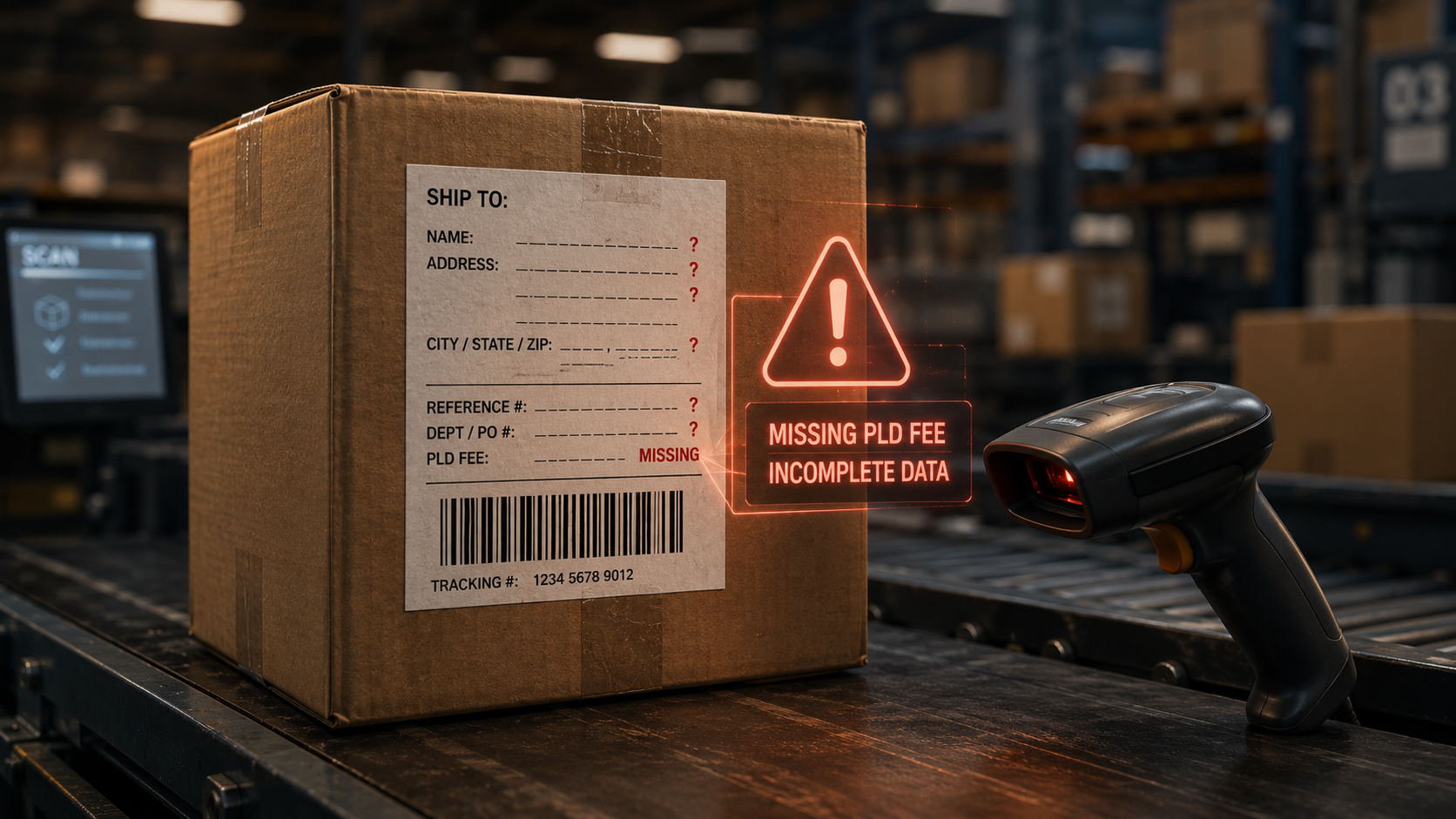
2026 UPS rate: The Missing Package Level Detail (PLD) fee is $4.70 per package when a shipper tenders a physical package to UPS without transmitting the required electronic shipment data in advance.
Quick answer: UPS charges a Missing PLD fee of $4.70 per package when you hand UPS a package that has no corresponding electronic record in their system. PLD — Package Level Detail — is the digital manifest data (tracking number, weight, dimensions, service, destination) that UPS requires before pickup. Without it, UPS can't sort, route, or bill the package automatically, so they charge you for the manual processing. At scale, this fee compounds into thousands per month.
Missing PLD charges are one of the most preventable accessorial fees — and one of the most commonly missed in manual invoice reviews. A UPS invoice audit catches missing PLD patterns and identifies the upstream integration failures that cause them.
For the broader compliance implications of missing PLD, see our analysis: Why Missing PLD Is a Compliance Issue, Not Just a Fee.
What the UPS Missing PLD fee means on your invoice, why UPS charges it, the integration failures that trigger it, and how to eliminate it permanently.
What Does PLD Mean in Shipping?
PLD stands for Package Level Detail — the electronic shipment record that must exist in UPS's system before a physical package enters their network. Think of it as the digital twin of your package. Every time you create a shipping label through UPS WorldShip, an API integration, or a multi-carrier shipping platform, that system transmits PLD to UPS containing the tracking number, shipper account, service level, package weight, dimensions, and destination address.
UPS's automated sortation facilities rely on PLD to route packages. When a package arrives at a UPS hub without a matching electronic record, the package can't be processed through standard automated systems. It requires manual intervention — someone has to look at the label, key in the data, determine routing, and apply charges manually. The Missing PLD fee covers the cost of that manual processing.
How Much Is the Missing PLD Fee in 2026?
The UPS Missing PLD fee is $4.70 per package in 2026. While $4.70 sounds small, it applies to every package tendered without electronic data — and the root causes that trigger it tend to affect entire batches of shipments, not individual packages.
A shipper processing 500 packages per day with a 5% missing PLD rate pays $117.50 per day — over $30,500 per year — on a single preventable accessorial fee.
Missing PLD Fee History
- 2025 (through 21 Dec): $4.40 per package
- 2026 (effective 22 Dec 2025): $4.70 per package
The fee rose from $4.40 to $4.70 with the December 2025 rate increase — signaling UPS's intent to push all shippers toward full electronic compliance.
What Triggers the Missing PLD Fee?
The fee is triggered when UPS scans a physical package at pickup or induction and cannot match it to an electronic shipment record. Common causes include:
- Manual label creation without system upload: Handwriting labels or printing labels from a standalone system that doesn't transmit data to UPS electronically.
- Integration failures: Your TMS, WMS, or shipping platform loses connectivity to UPS's systems during label creation. Labels print locally but the electronic record never reaches UPS.
- Batch upload timing gaps: You create labels during the day but your system only transmits PLD in an overnight batch. Packages picked up before the batch runs trigger Missing PLD.
- Third-party shipper errors: A 3PL or dropship supplier ships on your UPS account but doesn't transmit PLD through their system — yet the fee hits your invoice.
- Duplicate or voided labels: A label is voided in your system but the physical label is still applied to a package. UPS scans it, finds no active record, and charges Missing PLD.
- System migration issues: During WMS or shipping system transitions, electronic connectivity to UPS is disrupted. Packages ship with valid labels but no backing electronic data.
Why UPS Charges for Missing PLD
UPS's network is built for automation. Their hub sortation systems read the barcode on each package, match it to PLD, and route the package to the correct outbound trailer — all without human intervention. When PLD is missing, the package breaks this automated flow:
- It can't be sorted automatically — it's diverted to manual processing.
- Billing must be determined manually based on physical measurement and label reading.
- Service level and routing must be inferred rather than confirmed electronically.
- Address validation can't occur upstream, increasing delivery exceptions.
The $4.70 fee isn't punitive — it's a cost-recovery charge for manual processing that wouldn't exist if the electronic record arrived on time.
How to Eliminate Missing PLD Fees
Missing PLD is almost always a systems problem, not a people problem. Here's how to fix it permanently:
- Audit your current PLD failure rate: Pull a report of all Missing PLD charges from your last 90 days of UPS invoices. Group by shipping location, system, and time of day to identify patterns.
- Verify real-time connectivity: Ensure your shipping system transmits PLD to UPS at the moment of label creation, not in a delayed batch. Real-time API integration eliminates the timing gap.
- Monitor 3PL compliance: If third parties ship on your account, require confirmation that their systems transmit PLD for every package. Include PLD compliance in your 3PL SLAs.
- Implement pre-pickup validation: Before UPS arrives for pickup, run a reconciliation between physical packages staged and electronic records transmitted. Any mismatch means a package will trigger Missing PLD.
- Set up automated alerts: Configure your shipping system to flag any label creation event that doesn't receive a successful PLD transmission confirmation from UPS.
How to Dispute Missing PLD Charges
You can dispute Missing PLD charges when:
- Your system logs confirm PLD was transmitted before pickup (timing evidence).
- The charge was applied to a package that was voided and never shipped.
- UPS's system experienced a documented outage that prevented PLD receipt.
- The package was shipped by a third party without your authorization.
File disputes through UPS Billing Center with your system transmission logs as evidence. Success rates on PLD disputes with documentation are typically 60-75%.
Frequently Asked Questions
What does Missing PLD mean on my UPS invoice?
Missing PLD (Package Level Detail) on your UPS invoice means UPS received a physical package from you without a corresponding electronic shipment record. The $4.70 fee covers UPS's cost of manually processing the package through their network instead of using automated systems.
How do I fix Missing PLD charges?
Ensure your shipping system transmits electronic data to UPS in real-time at the moment of label creation — not in a delayed batch. Audit your integration connectivity, check 3PL compliance, and reconcile physical packages against electronic records before each pickup.
Can I dispute a Missing PLD fee?
Yes. If your system logs confirm PLD was transmitted before pickup, file a dispute through UPS Billing Center with your transmission logs as evidence. Disputes with documentation have 60-75% success rates.
Why does UPS charge for Missing PLD?
UPS's automated sortation network relies on electronic data to route packages. Without PLD, packages require manual processing — someone must read the label, determine routing, and enter billing data by hand. The fee covers this operational cost.
What is the Missing PLD fee in 2026?
The Missing PLD fee is $4.70 per package in 2026, up from $4.40 through 21 December 2025.
Related Reading
- Why Missing PLD Is a Compliance Issue, Not Just a Fee
- UPS Address Correction Fee 2026: $25.25 Per Package + Dispute Rules
- UPS 2026 Rate Increase: Complete Guide to Every Service and Surcharge Change
- Parcel Audit Services: How They Work & What They Recover in 2026
- Shipping Audit Guide 2026: What It Covers, What It Costs & How It Works
- Shipping KPIs: 5 Metrics That Actually Predict Cost Problems
Explore our UPS Invoice Audit & Freight Bill Recovery service.
This article is for informational purposes only. Carrier rates, surcharges, and policies change frequently — always verify current terms directly with the carrier for your specific situation. Have questions? Reach out to us — we're happy to help.

Meet the Author
paul@darrigoconsulting.com
I’m Paul D’Arrigo. I’ve spent my career building, fixing, and scaling operations across eCommerce, fulfillment, logistics, and SaaS businesses, from early-stage companies to multi-million-dollar operators. I’ve been on both sides of growth: as a founder, an operator, and a fractional COO brought in when things get complex and execution starts to break