January 22, 2026

What does UPS Large Package Surcharge mean and when is it applied?

What does UPS Large Package Surcharge mean and when is it applied?

What Does UPS Large Package Surcharge Mean and When Is It Applied?

Introduction: Why Large Parcels Cost More

As shipments grow larger, the cost of moving them doesn’t just rise in simple proportion—it jumps in defined steps. Oversized packages require different handling, routing, and labor. UPS’s Large Package Surcharge (LPS) is one such step, a pricing adjustment that reflects these operational complexities rather than just parcel weight.

Understanding the UPS Large Package Surcharge means looking past sticker shock to see the system beneath. When a parcel crosses certain size thresholds, UPS applies a surcharge designed to balance the extra resources needed to handle large, awkward shipments. This isn’t an arbitrary fee—it’s a structural response to real-world constraints in moving big packages through a network built primarily for standard parcels. In this article, I’ll walk through what the Large Package Surcharge is, the conditions under which it kicks in, and why it matters for anyone managing logistics costs at scale.

What Is the UPS Large Package Surcharge?

UPS applies the Large Package Surcharge (LPS) when a package exceeds defined dimensional limits. It is an accessorial surcharge—an additional fee added on top of the base shipping rate. This surcharge is distinct from Additional Handling fees, fuel surcharges, or demand-based pricing initiatives.

Key dimensional thresholds are as follows:

     
  • Domestic (United States):    
           
    • Length plus girth exceeding 130 inches, o
    •      
    • Longest side greater than 96 inches
    •    
     
  •  
  • International:    
           
    • Length plus girth exceeding 130 inches
    •    
UPS Large Package Illustration 3
     

A critical feature of LPS is that it sets a minimum billable weight of 90 pounds for affected packages (excluding UPS Ground shipments that use Freight Pricing). This means even if the package's actual or dimensional weight is lower than 90 pounds, shipping charges will be calculated as if it weighs at least 90 pounds.

The operational rationale behind LPS stems from the fact that oversized packages differ significantly from standard cartons. They may be non-conveyable (unable to move automatically on sorting equipment) and typically require manual handling, consume a disproportionate amount of cubic space in transport vehicles, and complicate sorting and routing. This surcharge aligns UPS’s pricing with the real costs of processing and transporting such packages.

How UPS Measures Package Size: Length plus Girth

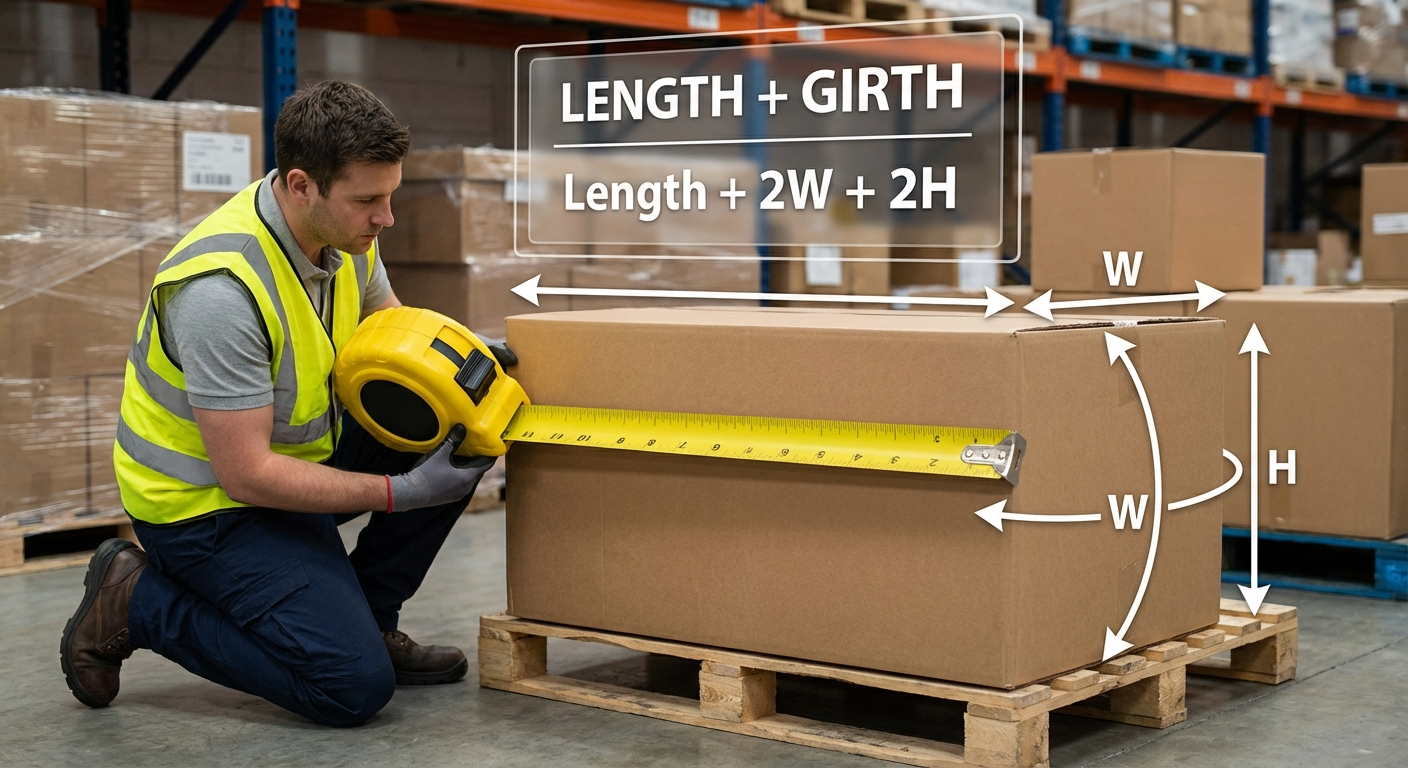
To evaluate large parcels, UPS uses a composite measurement called length plus girth. This is not simply the length of the package or its weight but a formula that captures the overall dimensional impact on handling and transportation resources.

The formula is:

Length plus girth = length + 2 × width + 2 × height

Here, length is defined as the longest side of the package. The girth is the combined perimeter around the package’s cross-section, calculated as twice the width plus twice the height.

Why this method? Because it effectively accounts for both very long, thin packages and short, bulky ones. A simple length measure fails to capture how width and height influence handling complexity and space consumption. Weight alone does not explain oversized challenges either—some large packages are light yet cumbersome and disruptive within parcel systems.

The LPS threshold is a length plus girth of more than 130 inches. Additionally, for domestic shipments in the U.S., packages with a length over 96 inches trigger LPS regardless of girth. UPS treats packages exceeding its published maximum parcel size limits differently, applying separate Over Maximum Limits fees as described in their tariffs.

When Is the Large Package Surcharge Applied?

UPS Large Package Illustration 1

The UPS Large Package Surcharge applies under the following dimensional circumstances:

     
  • Domestic shipments:    
           
    • Length plus girth exceeds 130 inches, or
    •      
    • The longest side exceeds 96 inches
    •    
     
  •  
  • International shipments:    
           
    • Length plus girth exceeds 130 inches
    •    
     

When this surcharge is applied, the minimum billable weight for shipping charges becomes 90 pounds, except for UPS Ground packages billed with Freight Pricing, where this minimum does not necessarily apply.

It’s important to note that LPS replaces Additional Handling charges for these oversized packages. In other words, packages subject to LPS do not incur Additional Handling fees, avoiding overlapping surcharges for the same operational complexity.

Certain exceptions exist where LPS does not apply:

     
  • UPS Authorized Return Service (ARS) UPS Ground shipments are exempt from LPS.
  •  
  • UPS Worldwide Express Freight shipments, oriented towards palletized freight, fall outside the LPS regime because they have separate fee and handling structures.

Furthermore, UPS has clearly defined maximum parcel dimensions. When packages exceed these maximums (dimensions published publicly), they do not simply incur LPS, but instead are subject to Over Maximum Limits fees. These fees involve higher charges or even potential shipment refusal due to equipment or network constraints.

In peak seasons or capacity-constrained network periods, UPS may also apply Demand Surcharges that can stack with LPS. These surcharges are usually published separately and vary based on time and region.

Examples illustrate how these rules operate in practice:

     
  1. Example 1 (Domestic, no LPS):
       Package dimensions: 40 × 20 × 15 inches
       Calculation: length (40) + 2 × width (40) + 2 × height (30) = 110 inches
       Since 110 inches < 130 inches and longest side < 96 inches, no LPS applies.  
  2.  
  3. Example 2 (Domestic, LPS due to length):
       Package dimensions: 100 × 8 × 8 inches
       Longest side: 100 inches (> 96)
       LPS applies with minimum billable weight 90 pounds; no Additional Handling charged.  
  4.  
  5. Example 3 (International, no LPS):
       Package dimensions: 50 × 20 × 18 inches
       Length + girth = 50 + 40 + 36 = 126 inches < 130 inches
       No LPS applies.  
  6.  
  7. Example 4 (International, LPS due to girth):
       Package dimensions: 60 × 24 × 24 inches
       Length + girth = 60 + 48 + 48 = 156 inches > 130 inches
       LPS applies.  
  8.  
  9. Example 5 (Exceeds maximum limits, no LPS):
       Package dimensions: 110 × 12 × 12 inches
       Longest side: 110 inches likely exceeds UPS maximum parcel limits
       Applies Over Maximum Limits charges, not LPS.  

Why UPS Implements LPS

Parcel transportation networks depend on predictability and efficiency. Conveyors, sorting machinery, trailers, and delivery vehicles are all engineered for parcels of typical dimensions and weights. Oversized packages disrupt this flow due to several factors:

     
  • Many oversized parcels cannot be processed via automated conveyor systems, requiring manual handling.
  •  
  • They occupy excessive cubic space within trailers and sort packages, reducing packing density and operational efficiency.
  •  
  • Manual handling increases labor time and package touches at every transit node: origin, sorting hub, and destination facility.
  •  
  • Oversized parcels complicate route planning, diminishing the number of stops per vehicle and requiring route adjustments.

The Large Package Surcharge serves as a tool for UPS to reconcile these added operational costs back to the shipper. The logistical effort to move oversized packages is inherently greater, thus costing more to process and deliver. Without the surcharge, carriers end up subsidizing these higher-cost shipments with revenue from standard-size parcels, which would erode network profitability and service levels.

With the steady increase in e-commerce and a growing number of shipments that are long, bulky, or heavy (for example, furniture, sporting goods, flat-pack products), the LPS is essential to preserve the economic balance of parcel networks.

For shippers, the LPS offers a market signal: optimize packaging to remain within the size thresholds where possible, or expect and budget for the surcharge as part of shipping costs. It encourages careful packaging design and product configuration to improve logistics efficiency.

Practical Implications for Shippers—and How to Mitigate LPS

To manage the Large Package Surcharge effectively, shippers can adopt a range of practical strategies:

     
  1. Accurate Measurement and Tracking
     Ensure dimensions are measured precisely using calibrated dimensioning equipment. Removing guesswork helps identify potential LPS triggers ahead of shipping. Incorporate this data into Warehouse Management Systems (WMS) or Order Management Systems (OMS) for tracking and cost forecasting.  
  2.  
  3. Packaging Design and Optimization
     Work backwards from the 130-inch length plus girth threshold and the 96-inch maximum side limits. Small adjustments in box dimensions may avoid triggering LPS. For example, reducing one dimension by an inch or two can keep an item under thresholds and eliminate the surcharge. Employ engineered packaging solutions such as right-sized boxes, foldable components, or molded inserts to reduce volume.  
  4.  
  5. Shipment Splitting
     When feasible and cost-effective, consider splitting large orders into smaller parcels to remain below LPS dimensions. However, weigh the overall costs carefully, as additional packaging, handling, and delivery charges could offset savings.  
  6.  
  7. Choosing the Right Shipping Mode and Carrier
     For extremely large items, UPS Worldwide Express Freight or UPS Ground Freight Pricing options may be more economical. These modes are designed for palletized or pallet-sized shipments with different fee structures. Compare rates across parcel carriers, less-than-truckload (LTL), and regional players to identify the best fit.  
  8.  
  9. Negotiation Based on Shipment Profiles
     Shippers with high volumes may negotiate custom terms with UPS that consider LPS surcharges. Back offers with detailed shipping data, highlighting patterns and exceptions to obtain better rates or surcharge waivers.  
  10.  
  11. Incorporate Minimum Billable Weight in Pricing Models
     Since LPS sets a 90-pound minimum chargeable weight on applicable parcels, factor this into cost estimates, customer pricing, and checkout processes to avoid surprises or cart abandonment.  
  12.  
  13. Establish Internal Oversize Policies and Training
     Configure e-commerce and warehouse software to flag shipments at risk of incurring LPS or Over Maximum fees. Train packaging staff to recognize dimension creep and the impact on surcharges. Instituting packaging guardrails helps limit unnecessary LPS charges.  

 A Note from the Operator’s Chair  From my experience overseeing operational logistics at Spend Management Experts, surfacing LPS fees clearly by SKU, channel, and mode uncovers many opportunities for improvement. Often, minor packaging tweaks or service shifts reduce not only surcharge expenditures but also damage rates and delivery issues. The broader benefit is a supply chain that operates smoothly, not one constantly battling oversized freight profiles.

Common Questions and Edge Cases

UPS Large Package Illustration 5
     
  • Does LPS stack with Additional Handling charges? No. UPS treats LPS and Additional Handling as mutually exclusive for large packages; only LPS is applied when appropriate.
  •  
  • Can LPS and Demand/Pick Season Surcharges apply simultaneously? Yes. Seasonal demand surcharges can be added on top of LPS during specific peak times.
  •  
  • What if my package is both heavy and large? The shipment cost will be based on the greater of dimensional/actual weight or the 90-pound minimum billable weight triggered by LPS, plus the surcharge itself. Packages exceeding maximum weight or dimension limits (rather than just LPS thresholds) incur Over Maximum Limits charges.
  •  
  • Are UPS returns subject to LPS? UPS Authorized Return Service UPS Ground packages are exempt from LPS. Other return shipments may incur it if meeting dimension thresholds.

Quick Reference Table: UPS Large Package Surcharge Thresholds and Exceptions

Feature Threshold / Rule Notes
Domestic LPS Trigger Length + girth > 130 inches OR longest side > 96 inches Minimum billable weight = 90 lbs
International LPS Trigger Length + girth > 130 inches Applies globally except exceptions
Exceptions UPS Authorized Return Service; UPS Worldwide Express Freight shipments No LPS applied
Over Maximum Limits Package exceeds UPS maximum parcel dimensions Separate over-maximum charges apply

Conclusion: A Necessary Pricing Signal in a Parcel Network

The Large Package Surcharge is not an arbitrary penalty but a reflection of true operational cost realities. Oversized parcels require more labor, space, and handling complexity, disrupting the balance of parcel networks engineered for standard packages. LPS compensates carriers appropriately while signaling shippers to optimize packaging and shipment modes.

The ongoing tension between customer packaging demands and carrier pricing structures will continue as parcel profiles evolve. Thresholds and fee schedules may change, but the fundamental relationship between size, handling complexity, and cost remains. For logistics systems to scale sustainably, price signals like LPS align shipper incentives with carrier operational realities.

Ultimately, understanding LPS arms shippers with the knowledge to anticipate fees, improve packaging strategies, and select the right delivery solutions—all critical factors in managing modern supply chains efficiently.

Sources:

 Disclaimer: This article is for informational purposes only and is based on publicly available UPS guidelines as of the time of writing. Shipping policies, fees, and thresholds are subject to change. Always consult UPS’s official publications or your UPS representative for the most current information.

Learn what triggers UPS’s Large Package Surcharge, how it’s calculated, and tips to avoid extra fees on oversized shipments. Manage your shipping costs smartly!

Meet the Author

I’m Paul D’Arrigo. I’ve spent my career building, fixing, and scaling operations across eCommerce, fulfillment, logistics, and SaaS businesses, from early-stage companies to multi-million-dollar operators. I’ve been on both sides of growth: as a founder, an operator, and a fractional COO brought in when things get complex and execution starts to break
email@example.com
+1 (555) 000-0000
123 Example Street, London UK
Thank you! Your submission has been received!
Oops! Something went wrong while submitting the form.