.png)
.png)


January 22, 2026
What does UPS Additional Handling – Dimension charge mean?

```html
What Does UPS Additional Handling – Dimension Charge Mean?
A practical operator’s guide to UPS’s Additional Handling – Dimension charge: what triggers it, why it exists, and how to avoid it with better measurement, packaging, and process.
Shipping costs aren’t just a line item they’re a fundamental operational lever in any logistics or eCommerce business. Yet, beyond base rates, carriers like UPS layer in a series of surcharges that often go unnoticed until they start chipping away at margins. One of the more subtle, but impactful fees is the Additional Handling – Dimension Charge.
This isn’t about griping over fees; it’s about understanding the operational logic behind why UPS applies extra charges for certain packages. Grasping how dimension-based handling surcharges arise and what triggers them gives operators the clarity to design packaging and processes that sidestep unnecessary costs. In this article, we’ll unpack what this charge really means, why it exists, and what practical steps can help you avoid it while scaling your shipping operations.
What is UPS Additional Handling – Dimension?
In straightforward terms, the UPS Additional Handling – Dimension charge is a fee applied when a package’s size falls outside the ranges UPS’s automated network can process smoothly. This charge is part of a broader category of additional handling fees UPS levies on parcels that require extra or manual processing beyond standard handling.
Specifically, the dimension-based Additional Handling applies when a package exceeds defined size thresholds, which complicate automated sorting and handling. These conditions include one or more of the following:
- The package’s longest side exceeds 48 inches.
- The package’s second-longest side exceeds 30 inches.
- The combined measurement of length plus girth (girth equals twice the width plus twice the height) exceeds 105 inches.
It is important to distinguish this from UPS’s Large Package Surcharge (LPS). The Large Package Surcharge is assessed at higher dimensional thresholds for instance, when the length exceeds 96 inches or the sum of length plus girth exceeds 130 inches. In those cases, the LPS applies instead of the Additional Handling – Dimension charge and generally carries a higher minimum billable weight requirement.
Why does this matter? Because the Additional Handling – Dimension fee can add a significant amount per package and quickly erode margins when shipping at scale. For companies pricing tightly on direct-to-consumer shipments or replenishment orders, even a single dimensional overage can eliminate profit on an entire shipment.


The Operational Logic Behind the Charge
1. Conveyor Limits and System Design
UPS parcel sorting hubs and facilities depend heavily on automated conveyor systems engineered to handle packages within specific dimensional ranges. When a package falls outside those parameters, it can’t travel through conveyors smoothly. Such packages require manual sorting, dedicated transport space, or special handling protocols. This adds labor, slows throughput, and complicates efficient operation.
2. Safety and Damage Risk
Oversized or irregularly shaped parcels are more difficult to safely lift, stack, or handle by workers or machines. Items that are long, bulky, or prone to rolling or snagging increase the risk of damage during handling. Managing these risks adds operational complexity and cost.
3. Incentives for Shippers
The surcharge is designed to encourage shippers to engineer packaging that conforms within established size parameters, thereby aligning the shipper’s behavior with the carrier’s optimized system. Packages conforming to constraints travel more predictably and cost-effectively; exceeding the limits imposes real costs that carriers recover through these fees.
For operators, understanding that this charge is not a punitive “fee” but a reflection of underlying logistics constraints transforms how they approach packaging design, process, and economics.
How UPS Measures: Practical Rules to Ship By
Accurately avoiding Additional Handling – Dimension surcharges begins with correctly measuring your packages — the way UPS does.
- Length is determined as the longest side of the package.
- Width and height are the other two dimensions, measured at their widest points.
- Girth is the perimeter of the package’s cross-section perpendicular to the length, calculated as:
Girth = 2 × Width + 2 × Height
Length plus girth is summed and checked against surcharge thresholds.
To avoid the Additional Handling – Dimension charge, the package must meet all these thresholds:
- Longest side length is 48 inches or less.
- Second-longest side length is 30 inches or less.
- Length plus girth combined is 105 inches or less.
If the package length surpasses 96 inches or length plus girth exceeds 130 inches, the package falls under the Large Package Surcharge instead.
A key billing nuance is that when the Additional Handling – Dimension charge applies, UPS often assigns a minimum billable weight (for example, 40 pounds) even if the actual package weighs less, so oversized parcels may generate higher shipping costs.
These policies and thresholds may change, so always verify the current UPS Small Business Rate Guide and Terms of Carriage before making packaging decisions.
Packaging Practices That Keep You Out of Trouble
Many Additional Handling fees stem from packaging that inadvertently breaches dimensional limits. Here’s how to design and select packaging to avoid triggering these charges:
- Use proper corrugated cardboard boxes: Rigid, corrugated boxes provide consistent shape retention. Avoid soft poly mailers or flexible wrapping for dense or irregularly shaped items, as these may bulge unpredictably and push dimensions beyond thresholds.
- Box irregular shapes completely: Cylindrical items, tubes, buckets, and other non-cuboidal shapes should be fully encased in corrugated cardboard. Exposed irregular shapes can trigger manual processing fees and increase the risk of damage.
- Eliminate protrusions: Strapping, banding, handles, or any external elements extending beyond the box footprint create snag risks and cause additional handling charges. Whenever possible, place these inside the box or avoid them entirely.
- Right-size your packaging: Oversized cartons and excessive void fill inflate dimensions unnecessarily. Consistently review and adjust box sizes to fit products more closely without compromising protection.
- Standardize SKUs to cartons: Assign standardized carton sizes to high-velocity SKUs and kits that conform to dimensional limits. Integrate carton selections into warehouse management systems (WMS) to reduce employee improvisation and variability.
Data Accuracy: The Cheapest Insurance You Can Buy
Even perfectly designed packaging will trigger unexpected surcharges if measured and recorded inaccurately in UPS systems. To prevent costly post-shipment billing adjustments:
- Measure packages precisely using reliable tools. Take measurements after sealing the box, at the widest points, and always round up fractions of an inch to the next full inch.
- Input exact length, width, height, and weight data into UPS shipping systems such as UPS.com, CampusShip, or WorldShip. Let these systems calculate dimensional weight and appraise surcharges accurately.
- Conduct regular audits of packed shipments to verify consistency between actual parcels and recorded data. Discrepancies cause billing surprises and complicate forecasting.
- Equip packing stations with dimensioning devices or develop standardized operating procedures using measurement jigs. This operational control greatly reduces adjustment invoices.
Examples: Quick Dimension Tests
Testing examples demonstrate how close dimension values can trigger fees:
- 50" × 12" × 10"
Longest side is 50" — exceeds 48". Additional Handling – Dimension applies. - 40" × 31" × 5"
Second-longest side is 31" — exceeds 30". Additional Handling – Dimension applies. - 42" × 16" × 10"
Length plus girth = 42 + (2×16) + (2×10) = 42 + 32 + 20 = 94" — within 105". No surcharge triggered by dimension. - 44" × 24" × 20"
Length plus girth = 44 + (2×24) + (2×20) = 44 + 48 + 40 = 132" — exceeds 130". Large Package Surcharge applies instead.
Common Pitfalls That Trigger the Fee (and How to Fix Them)
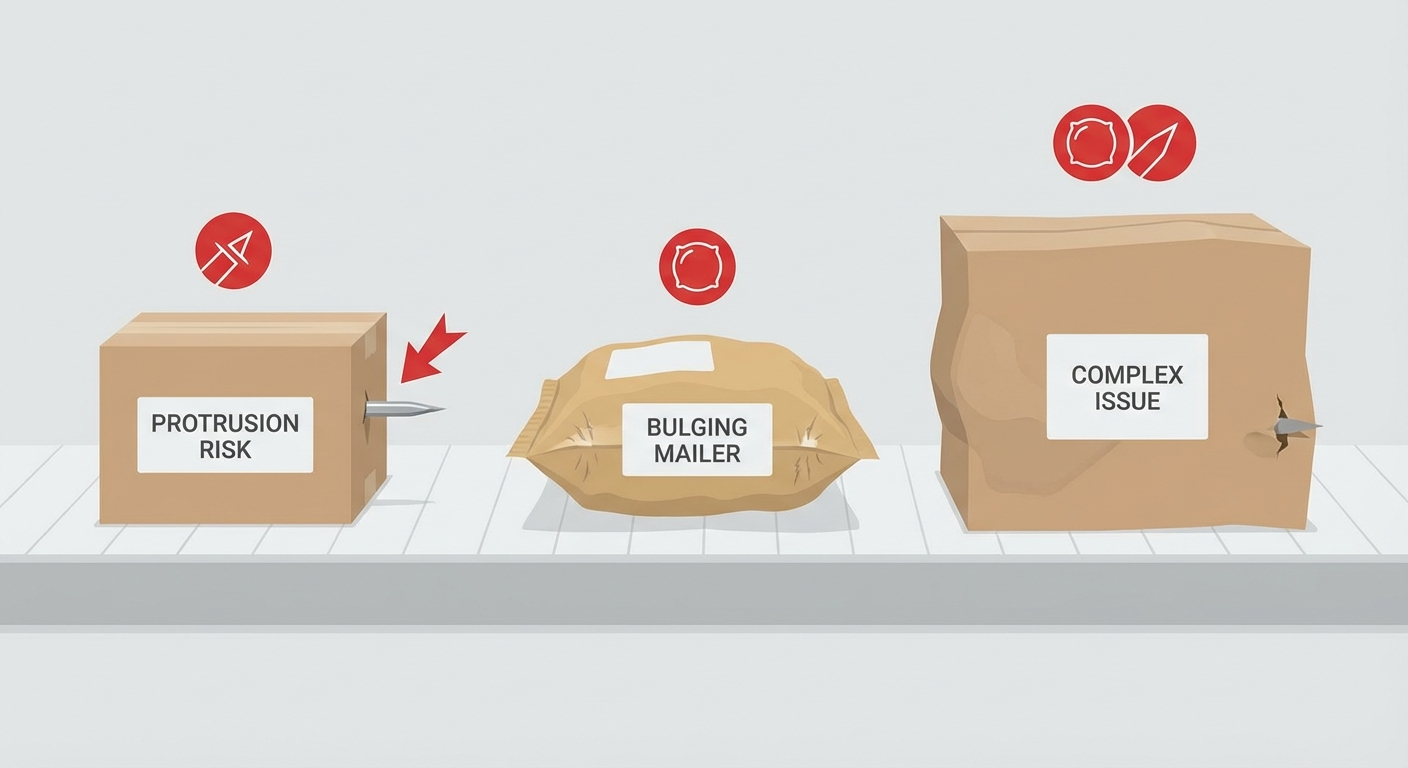
Some of the most frequent issues include:
- “Close enough” measurements: Even a half-inch shortfall on measurement can activate the surcharge. Train staff to measure meticulously and always round up.
- One-off packaging improvisation: A packer using an oversized box “just this once” can push dimensions into surcharge territory. Use WMS prompts or workflows to discourage non-standard packaging without approval.
- Bulging soft packs: Flexible poly mailers may seem low-cost but often bulge beyond size limits on denser or plank-shaped goods. Box these items properly.
- External banding and handles: Outside the box elements cause snagging and charge triggers. Reinforce or add handles inside the box instead.
- Dimension/weight mismatches: Inaccurate entries in shipping software result in carrier dimension scans producing adjustment invoices. Use dimensioning technology and perform random audits to combat this.
Where This System Might Change and Where It Won’t
Looking ahead, some forces may nudge changes, but the overall structure is stable:
- Infrastructure redesign: Conveyor and sorting technology could theoretically become more flexible, but capital expenditures for retrofitting or replacing millions of conveyor feet and system nodes make rapid change unlikely.
- Packaging innovation: Advances in lightweight materials or inserts that reduce carton size without sacrificing product protection can help businesses avoid surcharges while maintaining quality.
- Incentive tuning: UPS periodically adjusts fees and thresholds according to parcel profile evolution. Marginal shifts will occur but expect the fundamental principle rewarding packages that run cleanly, charging exceptions to endure.
- Automation and data accuracy: Dimensioning software and improved cartonization tools will reduce charge disputes and improve operational flow. Physical size constraints, however, remain immutable.
A Practical Playbook to Avoid Additional Handling – Dimension Charges
- Establish clear size specifications: Longest side ≤ 48", second-longest ≤ 30", length plus girth ≤ 105". Communicate these explicitly in training materials, guides, and warehouse systems.
- Standardize cartons: Rationalize your carton assortment to cover top SKUs within surcharges limits, eliminating unnecessary oversizing “just in case.”
- Use proper materials: Rigid corrugated cardboard for solid and long items; fully box irregular shapes so nothing protrudes.
- Calibrate and audit: Equip packing stations with measuring tools or dimensioners. Regularly audit shipments and track Additional Handling charge occurrences by site and SKU.
- Ensure accurate data entry: Enforce dimension and weight fields in shipping systems; reconcile adjustment reports regularly and retrain as needed.
- Analyze cost impacts before packaging improvements: Changes aimed purely at enhancing unboxing experiences should be vetted for dimensional surcharge impact if shipping costs are sensitive.
- Manage edge cases: Items consistently near dimension limits may justify custom cartons sized a fraction smaller than thresholds, eliminating recurring fees.
Billing Implications Worth Watching
- UPS bills based on the greater of actual or dimensional weight. Larger cartons can inflate dimensional weight, increasing base rates before surcharges.
- When Additional Handling – Dimension applies, UPS often applies a minimum billable weight (for example, 40 lbs) regardless of actual weight.
- Large Package Surcharges carry higher minimum weights and steeper fees.
Always review the latest UPS rate guides for current policies.
How I’ve Applied This in Practice
In managing a multi-site fulfillment network, we reduced Additional Handling – Dimension fees by:
- Re-specifying three commonly used cartons by 1–2 inches to stay within dimensional thresholds without compromising product protection.
- Introducing simple measuring jigs and enforcing rounding-up policies, reinforced with random audits, to instill accurate measurement habits.
- Updating the WMS carton recommendation engine to promote only threshold-compliant cartons for high-risk SKUs, eliminating guesswork for packers.
The result was a steady decline in post-shipment adjustment invoices, improved unit economics, and decreased finance team inquiries into shipping disputes.
Conclusion: Design to the Constraint, Stop Paying for Exceptions
The UPS Additional Handling – Dimension charge is not an arbitrary penalty. It signals the physical and operational constraints inherent in parcel logistics. UPS’s parcel handling systems are engineered to move packages within defined size parameters efficiently. Packages exceeding these thresholds require more labor, space, and risk management, so carriers recover costs through surcharges.
To reduce fees and avoid operational surprises:
- Measure packages exactly as UPS does.
- Design and select packaging to fit within 48"/30"/105" dimensional limits.
- Fully box irregular shapes and eliminate external protrusions.
- Enter dimension and weight data accurately into UPS shipping systems and audit regularly.
- Standardize carton selections and tune warehouse processes to enforce compliance.
Changes to surcharges and sorting processes will be incremental. The most effective lever for shippers is aligning packaging and operations within these physical constraints to remove recurring surcharges, minimize exceptions, and scale shipping with predictable costs.
Addendum: Quick Tools and References
- How to calculate length plus girth:
Length + Girth = Length + (2 × Width) + (2 × Height)
Keep this at or below 105 inches to avoid UPS Additional Handling – Dimension Charges.
- Fast checklist for pack stations:
- Is the longest side ≤ 48"? Yes / No
- Is the second-longest side ≤ 30"? Yes / No
- Is the length plus girth ≤ 105"? Yes / No
- Is the package fully boxed with no protrusions or external banding? Yes / No
- Are dimensions and weight accurately entered in the system? Yes / No
- UPS resources (confirm current thresholds before implementation):
- UPS Small Business Rate Guide (US)
- UPS Terms and Conditions of Carriage (US)
- UPS Tips to Avoid Additional Fees
This article respects the operational realities of shipping and is crafted for professionals managing efficient, scalable freight logistics. Specific thresholds and fees may evolve; always confirm the latest UPS publications before modifying packaging or pricing strategies.
Disclaimer: This article is for informational purposes only and does not constitute legal, financial, or professional advice. UPS surcharge policies may change; always consult official UPS fee guides and your carrier agreements before acting on this information.
Learn what triggers UPS Additional Handling – Dimension charges, why they matter, and practical tips to avoid costly surcharges with smart packaging and measurement.
```

Meet the Author
paul@darrigoconsulting.com
I’m Paul D’Arrigo. I’ve spent my career building, fixing, and scaling operations across eCommerce, fulfillment, logistics, and SaaS businesses, from early-stage companies to multi-million-dollar operators. I’ve been on both sides of growth: as a founder, an operator, and a fractional COO brought in when things get complex and execution starts to break