

May 27, 2026
UPS Digital Access Program (DAP): When Platform Rates Beat Your Contract
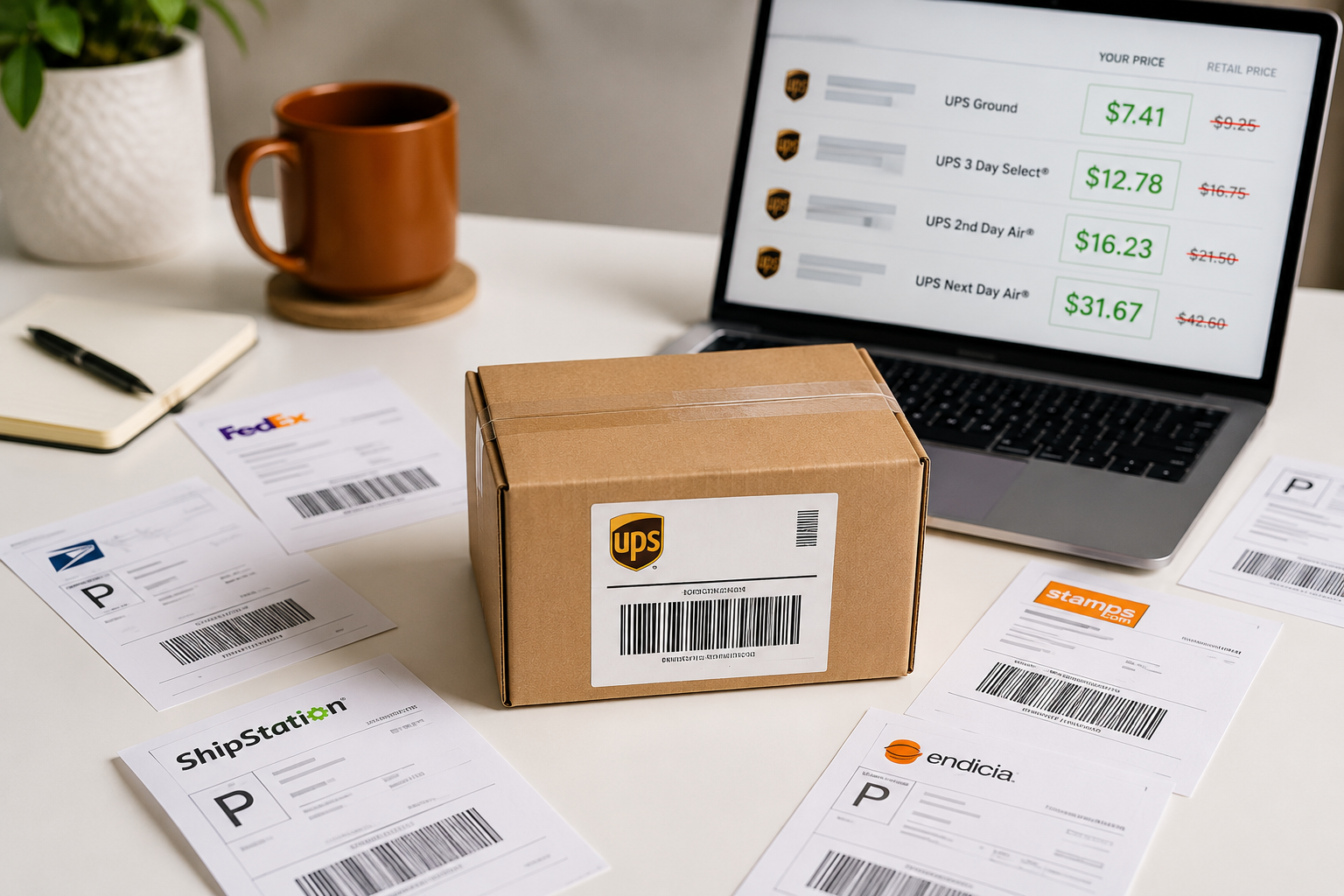
The UPS Digital Access Program (DAP) gives software platforms, Pirate Ship, Shopify, ShipStation, eBay, and dozens of others, pre-negotiated UPS rates that they pass through to sellers. For lightweight residential shipments under 5 pounds, DAP rates routinely beat both UPS retail pricing and many mid-market negotiated contracts. Many DAP platforms also offer UPS Ground Saver (check your platform or account), a residential economy service whose UPS rate sheet does not list a separate residential surcharge (UPS Ground adds $6.50 per residential package at 2026 Daily Rates).
Quick answer: If you're shipping lightweight packages to residential addresses and don't have a direct UPS contract (or your contract doesn't include aggressive surcharge waivers), DAP rates through a platform like Pirate Ship or ShipStation are probably cheaper than what you're paying now. If you're shipping heavy, high-value, or commercial packages, your negotiated contract almost certainly wins. The breakpoint is around 5 pounds, below that, DAP owns the math.
Key facts
- The UPS Digital Access Program (DAP) gives software platforms such as Pirate Ship, Shopify, ShipStation and eBay pre-negotiated UPS rates that they pass through to sellers.
- UPS Ground adds $6.50 per residential package at 2026 Daily Rates; UPS’s Ground Saver rate sheet does not list a separate residential surcharge.
- A 5 lb package to Zone 6 lists at $20.88 on UPS’s 2026 Ground Saver rate sheet versus $19.45 for UPS Ground at 2026 Daily Rates, before surcharges.
- UPS Ground Saver has a 70 lb maximum weight (150 lbs for UPS Ground) and a $50 maximum declared value with no add-on available.
- UPS’s 2026 Ground Saver rate sheet lists a $6.55 Delivery Area Surcharge, $8.85 for extended areas and $16.50 for Remote 48 Contiguous States ZIP codes.
- UPS DAP pricing can’t be combined with a direct UPS contract on the same shipment.
What the UPS Digital Access Program Actually Is
The Digital Access Program is UPS's channel partnership model. Instead of negotiating directly with every small shipper in the country, UPS cuts a single deal with a software platform, Pirate Ship, ShipStation, Shopify Shipping, eBay, Mercari, Stamps.com, and that platform passes UPS's discounted rates through to its users.
UPS benefits because it gets massive aggregate volume without maintaining thousands of individual contract relationships. Platforms benefit because discounted shipping rates attract and retain users. And shippers benefit because they get rates that would normally require $500K+ in annual volume to negotiate directly.
DAP isn't one rate card. Each platform negotiates its own deal with UPS, which means the rates on Pirate Ship aren't identical to the rates on ShipStation or Shopify. But the structure is the same across all of them: deep discounts off UPS Daily Rates (the "list price" for account holders), typically advertised as 50-85% off depending on service and weight.
What DAP is not: a negotiated contract. You can't call UPS and ask for your DAP discount to be modified, you can't negotiate accessorial waivers on top of it, and you can't combine DAP pricing with a direct UPS contract on the same shipment. It's a take-it-or-leave-it rate structure embedded in the platform you use to buy labels.
Which Platforms Offer DAP Rates
Virtually every major shipping software and eCommerce marketplace participates in UPS DAP. The rates vary by platform because each one negotiated separately, but all offer meaningful discounts over UPS Daily Rates:
| Platform | DAP Discount (Advertised) | Monthly Fee | Notable |
|---|---|---|---|
| Pirate Ship | Up to 85% off Daily Rates | Free | Full passthrough, no markup |
| ShipStation | Up to 77% off Daily Rates | $9.99+/mo | Check whether Ground Saver is offered |
| Shopify Shipping | Up to 82% off Daily Rates | Included with Shopify plan | Rates vary by Shopify tier |
| eBay | Up to 75% off Daily Rates | Free (with eBay account) | Built into eBay label purchase |
| Stamps.com / Endicia | Up to 82% off Daily Rates | $19.99/mo | Dual USPS + UPS discounts |
The "up to 85% off" claim is real but narrow, it applies to specific service/weight/zone combinations, not every shipment. A more realistic average across a mixed shipping profile is 30-55% off Daily Rates for ground services.
What DAP Rates Are Good For
DAP rates excel in one specific lane: lightweight residential shipments. The economics work because of two compounding advantages that apply below roughly 5 pounds.
Advantage 1: Deep base rate discounts on low weights. UPS's 2026 General Rate Increase averaged 5.9%. But DAP rates absorb much of this because the platform's aggregate volume justifies deeper discounting on the weight classes that generate the most label purchases. A 1 lb UPS Ground package to Zone 5 lists at $14.10 at 2026 Daily Rates but might cost $7-8 through a DAP platform, a spread that makes UPS competitive with USPS Ground Advantage for the first time in years.
Advantage 2: Possible access to UPS Ground Saver, which has no separate residential surcharge on its rate sheet. This is the big one. UPS Ground charges a $6.50 residential delivery surcharge on every package delivered to a home address. For a small shipper doing 500 residential deliveries per month, that's $3,250/month, $39,000/year, in surcharges alone. UPS Ground Saver, available to many shippers through UPS contracts and shipping platforms (check your account), is a residential-only service, and UPS’s Ground Saver rate sheet does not list a separate residential surcharge, so the comparison is the Ground Saver rate against the UPS Ground rate plus $6.50.
UPS Ground Saver: The Service That Changes the Math
UPS Ground Saver (formerly UPS SurePost) is an economy ground service available to many shippers through UPS contracts and shipping platforms. Check your UPS account or platform to confirm you can use it.
Here's what Ground Saver changes compared to standard UPS Ground:
| UPS Ground | UPS Ground Saver | |
|---|---|---|
| Residential Surcharge | $6.50 per package | None listed on the Ground Saver rate sheet |
| Transit Time | 1-5 business days | Typically UPS Ground transit plus about 1 to 2 business days (delivery generally Monday-Saturday) |
| Max Weight | 150 lbs | 70 lbs |
| Declared Value Coverage | Up to $50,000 | $50 max (no add-on available) |
| Service Guarantee | Day-definite (UPS guarantee currently suspended) | None |
| Signature Confirmation | Available | Not available |
| Delivery Photo | Yes | Not if USPS delivers last mile |
| Coverage Area | All 50 states + territories | Pickup in the 48 contiguous states; delivery to residential addresses in all 50 states, Puerto Rico, U.S. territories, PO Boxes and APO/FPO/DPO |
The tradeoff is clear: you give up speed, coverage limits, and service guarantees in exchange for avoiding the separate residential surcharge. For packages under 5 pounds going to residential addresses, the net cost after surcharges typically runs 10-30% lower with Ground Saver than with standard UPS Ground.
Where the Savings Break Down: The 5-Pound Threshold
Ground Saver's base rates are actually higher than standard UPS Ground base rates across most weight and zone combinations. A 5 lb package to Zone 6 lists at $20.88 on UPS’s 2026 Ground Saver rate sheet versus $19.45 for UPS Ground at 2026 Daily Rates, before surcharges. The savings come from the residential surcharge: the Ground Saver rate sheet lists no separate one, so once you add $6.50 to the Ground price, the math flips.
But that flip has a ceiling. As weight increases, the base rate gap between Ground and Ground Saver widens while the $6.50 residential surcharge you avoid stays fixed. Here's how the economics shift:
| Weight | Ground Saver Advantage | Typical Savings | Verdict |
|---|---|---|---|
| 1-2 lbs | Strong, the avoided $6.50 dominates | 20-30% per package | Use Ground Saver |
| 3-5 lbs | Moderate, still net positive | 10-20% per package | Use Ground Saver if transit flexibility OK |
| 6-10 lbs | Marginal, base rate gap nearly absorbs the $6.50 | 0-5% per package at short zones; negative at 10 lbs to Zone 8 | Compare on a per-shipment basis |
| 11+ lbs | None, standard Ground wins | Negative (paying more for slower service) | Use UPS Ground or negotiate a contract |
The operational rule is simple: under 5 lbs residential = Ground Saver. Over 10 lbs or commercial = standard Ground. Between 5-10 lbs = run the numbers on each shipment.
When DAP Beats a Negotiated UPS Contract
This is the question mid-market ops teams should be asking. If you're already shipping 1,000+ packages per month with a direct UPS contract, why would platform rates matter?
Because most negotiated contracts have blind spots, and DAP fills them:
Your contract probably doesn't waive the residential surcharge. Unless your UPS rep explicitly negotiated residential surcharge discounts or waivers, you're paying $6.50 per residential package on top of your contracted Ground rate. Many contracts focus on base rate discounts and ignore accessorials, which means a contract with "50% off Ground" still gets hit with full-price surcharges. Ground Saver, where your account or platform offers it, carries no separate residential surcharge on UPS’s rate sheet.
Your contract's minimum charge may exceed DAP rates on lightweight packages. Most UPS contracts include a minimum charge per package, typically $8-12 regardless of weight or zone. If you're shipping 1 lb packages, your contracted rate might floor at $9.50 while a DAP platform charges $5.50 for the same shipment. The lighter your average package weight, the more likely DAP wins.
Your contract may not include Ground Saver. Ground Saver requires separate contract activation. Many small-to-mid-size contracts don't include it because the sales rep didn't offer it or the shipper didn't know to ask. Some shipping platforms offer Ground Saver without a separate UPS contract; check what your platform or account shows.
Most shippers don't know which side of this line they fall on, because the answer is buried in twelve months of invoice data. A UPS invoice audit surfaces your real weight distribution, residential mix, and accessorial exposure, which is what actually decides whether DAP or a contract wins for your operation.
When a Negotiated Contract Beats DAP
Direct UPS contracts have advantages that DAP can never match:
Heavy package rates. Once you're above 10-15 pounds, a negotiated contract with tiered base rate discounts will outperform any DAP platform. The higher the weight, the bigger the gap. If your average package is 20+ lbs, DAP isn't competitive.
Accessorial waivers and discounts. A good contract can include percentage discounts or caps on fuel surcharges, delivery area surcharges, additional handling fees, and declared value charges. DAP platforms pass through all standard UPS surcharges with no modifications, you pay the published accessorial rate on every shipment.
Service guarantee. UPS currently keeps its Service Guarantee suspended for UPS Ground, so late Ground packages don't earn refunds today. Ground Saver has no service guarantee at all. If UPS reinstates the Ground guarantee, contract shippers who file late-delivery claims could recover some of the higher base rate.
Account-level support. Contract shippers get assigned account reps, custom billing, pickup schedules, and claims escalation paths. DAP shippers go through the platform's support team, which adds a layer between you and UPS when something goes wrong.
Commercial delivery rates. If a significant portion of your shipments go to business addresses, the residential surcharge is irrelevant and your contracted Ground rate is almost certainly lower than DAP Ground rates at any weight.
Paul's take: It's going to be different for everyone, so take this with that caveat. I'd say it's once you start spending more than a couple thousand a month. The key is whether you ship a very specific package. If you ship only one product in one box, you can go get a contract that's pinpoint targeted for just that, and you might be able to beat the DAP rates, the Digital Access rates you get through the online resellers. If you're a general eBay seller, or you sell a hodgepodge of random stuff, it's going to be tough to get a contract that covers that much breadth of services.
Paul D'Arrigo, D'Arrigo Consulting
The Surcharges DAP Does and Doesn't Address
One of the biggest misconceptions about DAP rates is that they eliminate surcharges. They don't, with one important exception:
| Surcharge | 2026 Rate | Ground Saver |
|---|---|---|
| Residential Delivery | $6.50 | None listed on the Ground Saver rate sheet |
| Fuel Surcharge | 30.25% for UPS Ground and Ground Saver, effective November 2, 2026 (changes weekly) | Still applies |
| Delivery Area Surcharge | $6.55 DAS, $8.85 Extended, $16.50 Remote 48 Contiguous States (Ground Saver rate sheet) | Still applies |
| Additional Handling | $26.75-$58.75 | Still applies |
| Peak/Demand Surcharge | $0.50-$8.00 (seasonal, by volume tier) | Still applies |
| Large Package | $219.50-$331.00 | Package ineligible for Ground Saver |
The delivery area surcharge deserves special attention. UPS’s 2026 Ground Saver rate sheet lists a $6.55 Delivery Area Surcharge, $8.85 for extended areas and $16.50 for Remote 48 Contiguous States ZIP codes. If you're shipping to rural or extended delivery areas, the DAS can easily wipe out any savings from avoiding the residential surcharge. Know your destination mix before assuming Ground Saver saves money across the board.
How to Decide: DAP vs. Contract Decision Framework
Here's a practical framework for deciding whether DAP rates, a direct UPS contract, or a hybrid approach makes sense for your operation:
Use DAP if: You ship fewer than 2,000 packages/month, your average weight is under 5 lbs, 70%+ of shipments go to residential addresses, you don't need service guarantees or signature confirmation, and your average order value is under $50 (so the $50 declared value cap doesn't create meaningful risk).
Use a negotiated contract if: You ship 3,000+ packages/month, your average weight is over 10 lbs, you ship a significant mix of commercial and residential, you require declared value above $50, or you need accessorial discounts on fuel, DAS, and additional handling.
Use both (hybrid): Route lightweight residential shipments through a DAP platform (using Ground Saver where it is offered), and route heavy, high-value, or commercial shipments through your direct UPS contract. This requires managing two label-printing workflows, but the savings can be substantial, we've seen operations save $15,000-30,000 annually by splitting traffic this way. Working out where your own split falls is exactly what a carrier contract and invoice review is for.
Setting It Up: Getting DAP Rates on Your Labels
Accessing DAP rates is straightforward. You don't need a separate UPS account to use most platforms' DAP rates, the platform's account relationship with UPS is what generates the discount. Here's what setup looks like on the major platforms:
Pirate Ship: Create a free account, connect your eCommerce store (Shopify, eBay, Etsy, WooCommerce, etc.), and start buying UPS labels immediately. No UPS account number required. Rates include Ground, 2nd Day Air, Next Day Air, and international services; check whether Ground Saver is offered for your account.
ShipStation: UPS DAP rates are available on all plans ($9.99+/month). Connect your store, and UPS rates populate automatically in the rate comparison view. Check whether Ground Saver appears as a service option for residential destinations in your account.
Shopify Shipping: Built into Shopify's admin. UPS rates appear alongside USPS in the shipping label purchase flow. Discount depth varies by Shopify plan tier, higher plans get steeper discounts.
eBay: UPS labels are available directly in the eBay shipping flow when you sell an item. Rates are applied automatically at eBay's negotiated DAP level.
Frequently Asked Questions
What is the UPS Digital Access Program?
It is UPS's channel partnership model. UPS gives software platforms such as Pirate Ship, Shopify, ShipStation and eBay pre-negotiated rates, and the platforms pass them on to sellers.
Who offers UPS DAP rates?
Nearly every major shipping software platform and eCommerce marketplace. Rates differ by platform because each one negotiated its own deal with UPS.
When do DAP rates beat a negotiated UPS contract?
On lightweight residential shipments, especially under 5 pounds. Heavy, high-value or commercial packages usually do better on a negotiated contract.
Do DAP platforms offer UPS Ground Saver?
Many do, so check your platform or account. Ground Saver is a residential economy service, and its UPS rate sheet does not list a separate residential surcharge. UPS Ground adds $6.50 per residential package at 2026 Daily Rates.
Shipping costs are an operations problem
D'Arrigo Consulting works with e-commerce, fulfillment and distribution companies in a fractional COO role. Parcel and freight spend is part of that work, along with fulfillment, inventory and the systems behind them. Tell us what's going on.
Disclaimer: This article is for informational purposes only and does not constitute financial, legal, or professional consulting advice. Rates, surcharges, and program details referenced are based on publicly available information as of September 2026 and are subject to change. Always verify current rates directly with UPS or your shipping platform before making operational decisions. D'Arrigo Consulting LLC is not affiliated with or endorsed by UPS, Pirate Ship, ShipStation, Shopify, or any other platform mentioned in this article.

Meet the Author
paul@darrigoconsulting.com
I’m Paul D’Arrigo. I’ve spent my career building, fixing, and scaling operations across eCommerce, fulfillment, logistics, and SaaS businesses, from early-stage companies to multi-million-dollar operators. I’ve been on both sides of growth: as a founder, an operator, and a fractional COO brought in when things get complex and execution starts to break