.png)
.png)


January 22, 2026
The Hidden Cost of Treating Parcel Like Freight

The Hidden Cost of Treating Parcel Like Freight
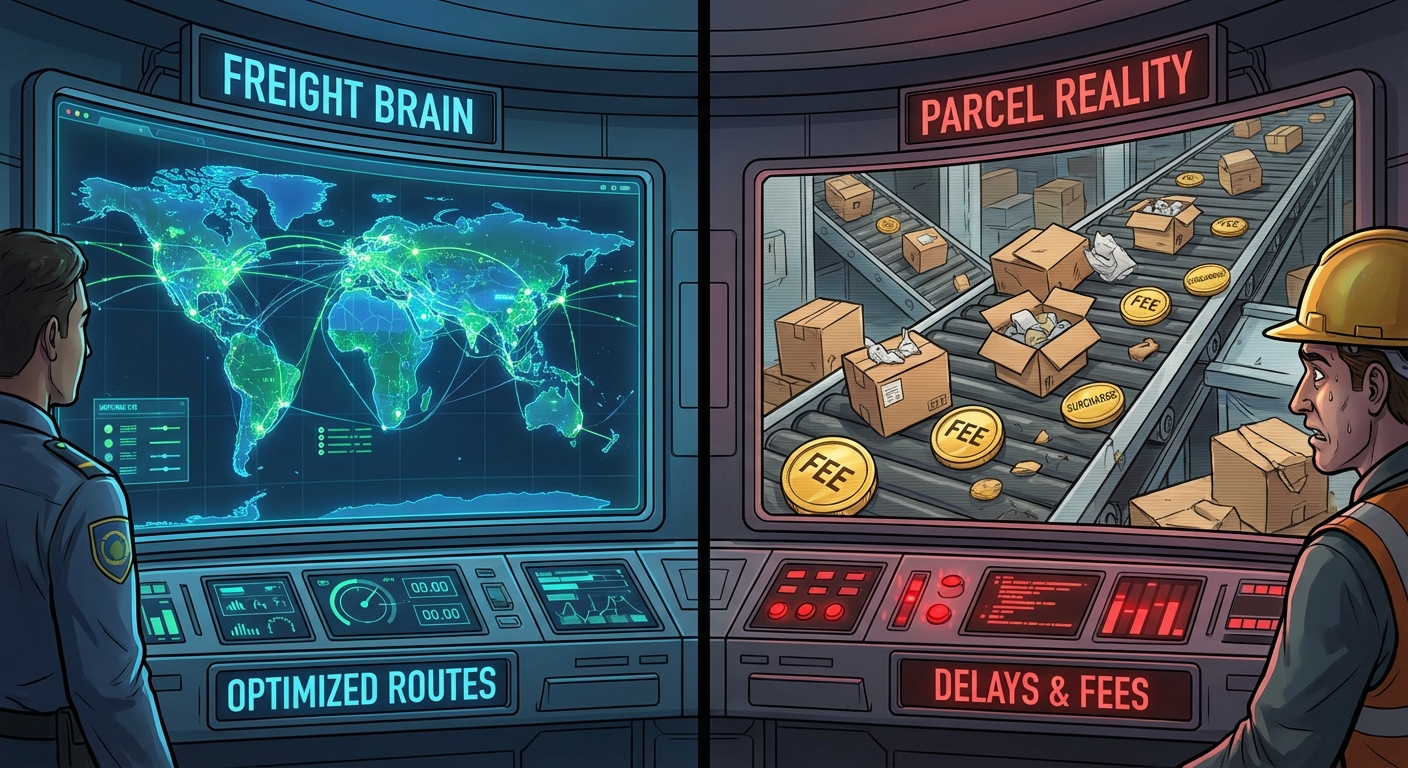
Parcel and freight: they both move goods, but their cost structures couldn’t be more different. Yet, I still see companies treating parcels like freight shipments—and it’s quietly costing them more than they realize.
Most shippers default to freight logic when managing parcel deliveries, assuming weight and volume rules apply equally. The reality is parcel carriers build pricing around dimensional weight and a complex web of accessorial fees linked directly to package specifics. This mismatch creates hidden costs that scale quickly and quietly erode margins. Understanding why parcel pricing works differently—and adjusting operational practices accordingly—is essential to stopping unnecessary spend before it becomes a systemic problem. This article breaks down the key differences and practical steps you can take to align your systems with parcel realities, not freight assumptions.
Understanding the Parcel vs. Freight Cost Dynamic
While parcel and freight both transport physical goods, the underlying economics and operational models differ fundamentally. Many shipping teams apply freight logic—weight and volume plus a handful of surcharges—to parcel shipments. On the surface, this sounds reasonable: after all, a package that weighs 10 pounds should cost less than one weighing 50 pounds regardless of shipping mode, right? Unfortunately, this oversimplification leaves a large gap between expectation and reality. Parcel carriers operate under a distinct cost structure that weighs dimensional factors and enforces numerous accessorial fees tied to specific package characteristics. Freight, by contrast, focuses on consolidated loads over defined lanes with fewer penalties on package quirks.
Parcel carriers, including FedEx and UPS, optimize for speed, density, and network throughput. That network optimization grants them tremendous efficiency but requires very precise packaging and data compliance to avoid fees. Treating parcel shipments like small freight loads—loose or overpackaged, assuming dimensional weight is a secondary concern—is a recipe for repeated, often invisible charges that quietly inflate overall shipping spend.
This article aims to unpack the actual parcel pricing framework, contrast it with freight pricing logic, expose common misconceptions that fuel overspending, and propose operational changes to keep parcel costs under control without sacrificing service or scalability.
How Parcel Pricing Actually Works
Dimensional Weight Pricing
Parcel carriers price shipments predominantly by the higher of actual weight or dimensional (DIM) weight. DIM weight is a billing standard reflecting the cubic space a package occupies relative to its physical weight, calculated as length × width × height divided by a carrier-specific dimensional divisor. This divisor varies by carrier and can change periodically, reflecting network conditions and capacity constraints. (For current information, see FedEx’s Additional Shipping Fees and UPS’s Avoid Additional Shipping Fees pages.)
For example, imagine a product weighing 7 pounds shipped in a box measuring 22 inches long, 16 inches wide, and 10 inches high. The volume is 3,520 cubic inches. Using a DIM divisor of 139, the DIM weight calculates as:
3,520 ÷ 139 ≈ 25.3 lbs
Carriers round up, so the billable weight becomes 26 pounds—nearly four times the actual product weight. This inflated charge reflects the space occupied within the carrier’s trailer or aircraft, not just the weight handled. For high volumes, such disproportionate billing can translate into thousands or millions of dollars in excess spending.
The package shape and condition further influence pricing. Soft or irregular packages like bulging poly mailers may measure larger or trigger additional handling fees from carriers because they deviate from uniform dimensions the network is built to accommodate. Unlike freight, where mixed pallet loads and irregular shapes are the norm and deeply integrated into pricing logic, parcel networks maintain tight standards on size and shape to enable fast sorting via automation.
Accessorial Fees: The Hidden Multipliers
Besides the base rate, parcel shipments often incur a range of accessorial fees—small charges that add up. Common accessorials include:
- Additional handling: Fees for packages with odd dimensions, that are excessively heavy, or use non-rigid packaging. These penalties recognize the extra labor or equipment needed to process outliers.
- Oversize or large package surcharges: Applied when the sum of length plus girth goes beyond carrier limits.
- Residential and delivery area surcharges: Extra charges depending on the delivery destination, such as residential addresses, rural areas, or remote zones.
- Address corrections: When incomplete, inaccurate, or invalid addresses require carrier intervention during delivery.
- Signature requirements, Saturday delivery, or on-call pickups: Service-specific or customer-requested fees.
- Carrier audits and adjustments: Incurring costs from re-measured or re-weighed packages if declared dimensions or weights differ from the carrier’s assessment.
Individually, these fees might seem negligible, but they accumulate over thousands of shipments to form a significant portion of total parcel spend. Carriers periodically revise fee structures, sometimes expanding definitions or tightening tolerances, which means constant attention and adaptation by shippers.
Key Insight
Parcel costs are highly granular, tied closely to package dimensions, quality of packaging, and data accuracy. Freight experience is valuable to move goods at scale but doesn’t seamlessly translate into parcel cost avoidance unless packaging and shipment preparation align with parcel-specific requirements.
The Misconception of Treating Parcel Like Freight
Freight Pricing Logic
Freight pricing is generally heavier on weight or volume, chargeable by the pallet or skid, and incorporates lane-specific factors and product classification regimes through the National Motor Freight Classification (NMFC) or similar systems. While accessorial fees exist in freight (e.g., liftgate, inside delivery, limited access pickups), they tend to be fewer and less sensitive to very granular package details. Freight pricing is designed to absorb variability at the shipment level—pallet sizes, mixed loads, and complex product mixes.
Carriers expect long haul moves, consolidated freight patterns, and standard pallet configurations. The system accounts for distance, density, and routing complexity and facilitates a relatively simplified picture of shipment cost, emphasizing lane economics over individual package anomalies.
Why Parcel Systems Are Different
Parcel carriers move millions of individual parcels daily through high-speed automated sort hubs that require well-defined size, shape, and documentation standards. Scanning and measurement technologies automatically enforce these standards, generating precise dimension and handling data that drive billing. Pricing is carefully calibrated to encourage right-sizing packages and clean data because any deviation ramps network strain and costs.
Applying freight-pricing assumptions to parcel shipments creates issues:
- Packages that physically “fit” may trigger inflated DIM weight charges.
- Multi-box orders without right-sizing waste billable space and trigger handling fees.
- Loose address data translation flows into correction surcharges.
- Overuse of premium services, e.g., air expedited, mimics freight’s longer lead times assumption but at parcel prices.
Real-World Consequence
Rather than isolated invoice errors, shippers face a steady drip of small fees that add up repeatedly over thousands of parcels, quietly inflating costs beyond expectations. These hidden expenses often get overlooked in budgeting or forecasting because they don’t fit traditional freight cost models.

Operational Approaches for Reducing Parcel Costs
Reducing parcel costs hinges on operational discipline, aligning packaging, data, auditing, service selection, and monitoring with parcel-specific realities.
Right-Sized Packaging and Standard Shapes
- Develop a packaging strategy with a curated set of carton sizes aligned closely to your product dimensions, eliminating infrequent and “oversized” exceptions.
- Design packaging to remain below DIM weight thresholds and avoid additional handling triggers documented by carriers such as UPS and FedEx.
- For poly mailers and flexible packaging, minimize bulging and irregularities that expand dimensions artificially.
- Install precise dimensioning and weighing equipment on packing lines and train staff to capture exact external measurements, recognizing that carriers validate these during shipping.
Data Accuracy and Address Validation
- Use carrier-certified address validation APIs integrated within order and fulfillment workflows to detect missing apartment numbers, typographical errors, and ZIP+4 mismatches before shipping.
- Normalize incoming address data from marketplaces and customer inputs to reduce variability and downstream correction fees.
- Monitor patterns of correction charges by channel, SKU, or geography to uncover root causes and develop targeted solutions.
Auditing and Contract Management
- Audit every invoice to catch double charges, missed late-delivery refunds, wrong classification of residential vs. commercial shipments, or inconsistencies in DIM weight data.
- Negotiate contract terms aggressively to cap or waive frequent accessorial fees, focusing on the largest penalty drivers such as additional handling or residential surcharges.
- Align carrier incentives through shared volume forecasts and committed shipping profiles to reduce billing surprises.
- Stay abreast of carrier policy changes—including rounding methods, new audit fees, or minimum weight adjustments—using trusted sources like AlixPartners bulletins.
Service Level and Mode Optimization
- Rate shop parcel service levels against delivery time requirements so you avoid paying premium air or expedited fees unnecessarily.
- Establish clear business rules guiding when premium services are warranted versus ground economy options.
- Analyze multi-box or bulky parcel orders for consolidation potential via less-than-truckload (LTL) freight shipments to reduce per-unit costs and damage risk.
- Employ data-driven scenario modeling to compare parcel and LTL options, replacing assumptions with evidence-based decisions. Red Stag Fulfillment and Transportation Insight provide guidance on these comparisons.
Continuous Monitoring of Carrier Policies
- Maintain a live, updated inventory of carrier pricing rules, surcharges, and dimensional definitions.
- Adjust warehouse management systems (WMS) and transportation management systems (TMS) logic rapidly as carrier policies evolve.
- Train operations and customer service teams regularly to stay current on parcel carrier requirements, preventing process erosion.

Why This Matters: Operational and Strategic Implications
Impact on Margins and Scalability
Hidden parcel fees chip away at profit margins and disrupt cost forecasting accuracy. Without foundational adjustments to packaging, data collection, and auditing, shipping costs rise disproportionately as volumes grow—squeezing profitability and obscuring the real cost to serve.
Systems Thinking: Aligning Warehouse, Technology, and Carrier Strategy
Effective parcel cost management requires cross-functional coordination:
- Warehouse teams must enforce packaging standards, dimensioning accuracy, and quality controls.
- Technology solutions must provide address validation, cartonization logic, rating engines, and invoice audit automation.
- Carrier strategy must focus on negotiation, service mix optimization, and ongoing performance analysis aligned with actual cost drivers.
Fragmented or siloed approaches rarely produce sustainable savings long term.
Long-Term View
Parcel cost management isn’t a one-time fix but a continuous operational discipline requiring vigilance and adjustment as carriers refine rules and marketplace dynamics evolve. Punitive fee structures reward shippers who conform and penalize those who resist detailed compliance.
A Practical Example from the Floor
In consulting engagements, I’ve seen clear examples illustrating parcel vs. freight misalignment costs and simple operational fixes:
- A health and beauty company shipped 6–8 lb products in large, luxury-style cartons prioritizing unboxing experience over cost. These packages consistently incurred billable weights of 20+ lbs with numerous handling fees. Switching to right-sized cartons plus standard void fill cut billable weight by a third and eliminated most additional handling charges. Margins improved measurably without service loss.
- A B2B marketplace seller suffered costly address correction fees from incomplete customer addresses missing suite numbers. Integrating address validation within order capture eliminated many corrections, reducing fees and boosting first-time delivery success, which lowered customer support costs.
- A home goods retailer sent multi-box parcel shipments to the same buyer using separate labels and carriers. Modeling showed consolidating these shipments via palletized LTL cut costs per order substantially and lowered damage claims. For retailer compliance shipments, this approach simplified receiving and reduced overhead.
None of these changes were radical inventions—rather, incremental improvements embedded in standard workflows that scaled and endured.

What Good Looks Like: An Operator’s Checklist
- Carton Architecture: Maintain a lean, quarterly-reviewed set of cartons keyed to SKU dimensions.
- Measurement Discipline: Use properly calibrated scales and dimensioning equipment; digitally capture data at packing.
- Data Hygiene: Enforce carrier-certified address validation before label generation; normalize data from all sources.
- Rating and Mode Logic: Automate rate shopping by service level; run scenario modeling for multi-box orders comparing parcel and LTL.
- Audit and Analytics: Automate invoice audits; link accessorial fees to root causes by SKU, channel, and geography.
- Carrier Management: Regularly renegotiate terms; monitor policy updates to adapt promptly.
- Feedback Loop: Train packaging teams on DIM weight thresholds; review SOPs monthly focusing on exceptions and trends.
Conclusion: Realistic Paths to Managing Parcel Costs
Parcel and freight operate under fundamentally different network designs, pricing logics, and incentive structures. Freight assumes consolidated lanes, tolerance for pallet variation, and volume discounts. Parcel pricing enforces strict dimensional and data standards to protect network flow and throughput. Applying freight logic to parcel shipments invites a cascade of small, repeated penalties that quietly inflate total shipping spend.
The solution doesn’t come from contract gimmicks or blanket policies but from incremental, system-aligned operational improvements such as right-sized packaging, accurate measurement, robust address validation, disciplined auditing, service-level controls, and LTL consolidation where appropriate. Embedding these practices into technology platforms and operational workflows ensures cost control that can scale with volume and organizational change.
Carrier pricing rules will not simplify; if anything, complexity will increase. Shippers must accept this reality, build systems and teams aligned to parcel economics, and treat parcel cost management as a continuous, proactive discipline rather than a reactive exercise. Those who do will protect margins, improve forecasting accuracy, and build parcel operations that scale efficiently and sustainably.
References
- FedEx Additional Shipping Fees
- UPS Avoid Additional Shipping Fees
- AlixPartners, Big Changes to Small Parcel Accessorial Fees
- Transportation Insight, Identifying and Eliminating Hidden Parcel Shipping Costs
- Red Stag Fulfillment, LTL vs. Parcel Shipping Cost Comparison
Disclaimer
This article is intended for informational purposes only and does not constitute legal, financial, or professional advice. Shipping rates, carrier policies, and regulations are subject to change. Readers should consult carriers and professionals to confirm applicability to their specific operations.

Meet the Author
paul@darrigoconsulting.com
I’m Paul D’Arrigo. I’ve spent my career building, fixing, and scaling operations across eCommerce, fulfillment, logistics, and SaaS businesses, from early-stage companies to multi-million-dollar operators. I’ve been on both sides of growth: as a founder, an operator, and a fractional COO brought in when things get complex and execution starts to break