.png)
.png)


Modern AI On Top Of Old WMS Software: No Rip-And-Replace Required

How AI can sit on top of legacy WMS platforms using reports, exports, APIs, or CSVs to deliver insights without requiring a full system migration.
Hook:
Most warehouses run on warehouse management systems (WMS) designed long before AI entered the conversation. These legacy platforms are reliable but rarely built for today's demands, real-time insight, flexibility, and continuous improvement. Yet swapping them out wholesale isn't just costly; it's often impractical.
Introduction: The Legacy WMS Challenge in Modern Operations
Replacing an entrenched WMS with a new one can take years and disrupt critical operations. As a result, many logistics leaders find themselves stuck between outdated technology and the pressure to modernize. The question isn't whether we can add AI to warehouse operations, it's how to do it without tearing down what still works.
Most warehouses today rely on WMS platforms built years or even decades ago. These legacy systems often have served their roles well, underpinning inventory control, order management, labor allocation, and shipping operations reliably. But they were not originally designed with the agility or insight generation modern AI tools require. Real-time anomaly detection, dynamic slotting, or labor forecasting are frequently out of reach in these environments.
Moreover, the idea of replacing the entire WMS is daunting. Full rip and replace projects can drag on for years, tying up resources while risking operational disruptions. From running a 30-year-old logistics business, I can attest firsthand, your WMS is your backbone; you don't casually reboot it.
The reality and the opportunity is different: build on top of what works, add an AI-enabled integration layer, and let that layer feed insights and recommendations back into operations. This approach is known as the "leave and layer" or "strangler fig" pattern, a proven method advocated by major cloud providers and software architects alike.


Why Rip and Replace Isn't the Default Path
Rip and replace sounds simple in theory but runs into practical roadblocks:
- Downtime is expensive. Warehouses rely on uninterrupted throughput. Even a short pause cascades through staffing, freight scheduling, and customer fulfillment.
- Legacy systems are highly customized. Over years, firms have tailored their WMS with unique workflows, integrations to carriers, accounting, and labor management. Replicating all this in a replacement system is challenging.
- Risk tolerances are low. Delays, data migration errors, or missing features in a new system can immediately hurt customer service and revenue.
- Costs often balloon. Long replacement projects require more resources and management oversight than initially estimated.
Consequently, many organizations defer the monumental task of replacing their core WMS, even when their business demands outgrow existing capabilities. Instead, they "make do" or attempt point improvements with bolt-on software. Unfortunately, this can lead to brittle and fragmented systems.
A more effective and pragmatic strategy is to embrace layering. Keep the stable legacy WMS core but add modern integration and AI layers that augment and enhance without disrupting the existing operation.
The Leave and Layer Approach: Building an Integration Façade
How do you modernize without touching the core? The answer is to create a thin but robust integration façade around the legacy WMS. This façade acts like a circuit breaker: it intercepts and publishes data changes and states while preserving the system inside.
Key aspects include:
- Preservation of the WMS as-is. Resist temptations to overhaul or refactor the core WMS, except where clearly justified by return on investment.
- Integration façade. Build a lightweight interface, exposing existing APIs or wrapping the WMS with adapters and gateways. This provides clean, contract-first endpoints to other systems.
- Event-driven architecture. Publish operational events, order updates, picks completed, inventory counts changed, appointments rescheduled, onto an event bus. Technologies such as Kafka or AWS EventBridge enable this. Event-driven messaging decouples the legacy transactional core from new services.
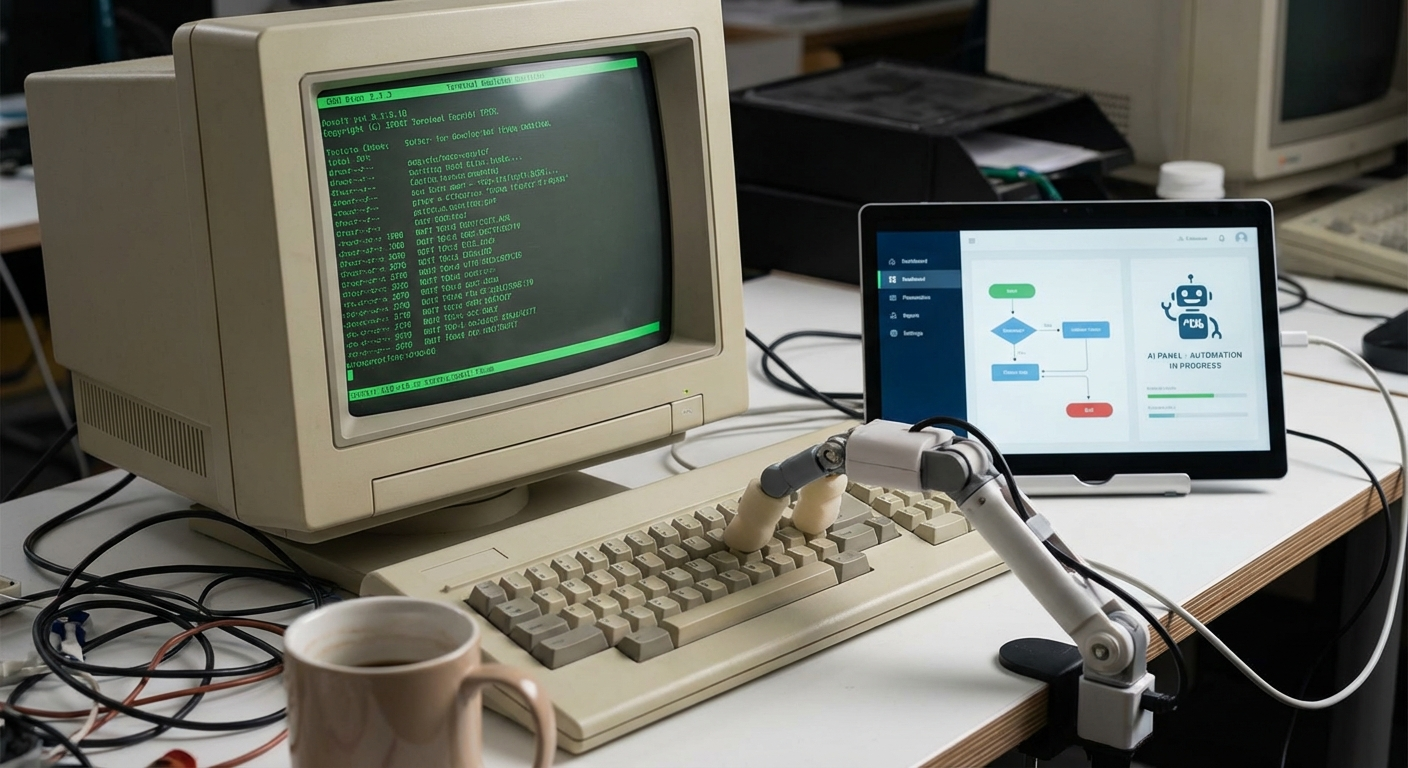
- Non-invasive automation where APIs are missing. Use robotic process automation (RPA) or terminal emulation to interact safely with green-screen interfaces or proprietary terminals without code changes in the core system.
This pattern, often called the "strangler fig" after a tree that grows around and eventually replaces its host, lets the integration layer gradually take on operational intelligence and optimization. Meanwhile, the legacy WMS continues stable transaction processing. If the integration layer fails or requires maintenance, the warehouse operation remains unaffected.
How AI Fits Into the New Layer
Artificial intelligence thrives on data, structured, timely, and clean. The legacy WMS inside the integration façade remains the system of record but often cannot be modified or queried in real time. The layered architecture solves this by feeding AI models from controlled data streams and curated exports.
Inputs for AI in this context commonly include:
- Scheduled report files or CSV exports containing inventory, orders, shipments
- API reads for orders, tasks, stock levels
- Change data capture (CDC) streams or ETL pipelines where feasible
- Event streams reflecting WMS transactional events and state changes
With these, a governed data store is built, enabling AI to analyze and learn from operational history and current state. Use cases well suited for this layered model include:
- Slotting optimization. AI recommends better storage locations for SKUs, reducing travel time and congestion.
- Labor planning and productivity forecasting. Forecasts staffing needs per shift or zone based on expected throughput and historic order patterns.
- Real-time anomaly and exception detection. Flag unusual delays, picking rates, or inventory discrepancies proactively.
- Replenishment triggers. Anticipate and suggest stock moves before picking stations run out.
- Dock and yard scheduling optimization. Sequence carrier appointments to minimize dwell time.
Crucially, AI does not overwrite the WMS but provides actionable insights and recommendations. Outputs flow back to the frontline through:
- APIs posting priority suggestions or task updates
- Automated RPA-driven task assignments or terminal inputs
- Alerts or emails to supervisors and operators
- Files dropped in locations the WMS reads from
This decision-support or semi-automated orchestration preserves the integrity of the legacy system while unlocking modern intelligence.
Architectural Components and Best Practices
For a mature "leave and layer" stack, several architectural elements and best practices ensure reliability and scalability:
- Integration façade with contract-first API design. Define schemas and data contracts clearly to maintain compatibility and avoid surprises as systems evolve.
- Event bus or streaming platform. Use a distributed, durable messaging system (e.g., Kafka, AWS EventBridge) to decouple producers and consumers and ensure reliable event delivery.
- Data pipelines framework. Employ CDC or ETL processes to populate a curated data store for AI model training and inference.
- Schema registry and versioning. Register event formats, enforce strict version management, and treat breaking changes as major incidents needing attention.
- Security controls. Implement role-based access control, encrypt data at rest and in transit, limit Personally Identifiable Information exposure, and maintain audit logs.
- Observability and monitoring. Track event flow health, schema validation failures, pipeline latency, and data quality. Alert proactively on abnormalities, not just infrastructure outages.
- Workflow orchestration engine. Manage composite AI-enhanced processes, such as wave generation or replenishment workflows, outside the WMS core to avoid tampering.
- Feedback channels. Establish safe, governed paths back to the WMS via APIs, RPA, or file exchanges.
Delivery Approach
Successful implementation follows careful incremental rollout:
- Start with low-risk, read-only use cases. For example, generate daily slotting optimization recommendations without pushing changes back.
- Measure impact and build trust. Present insights as dashboards, reports, or alerts to supervisors.
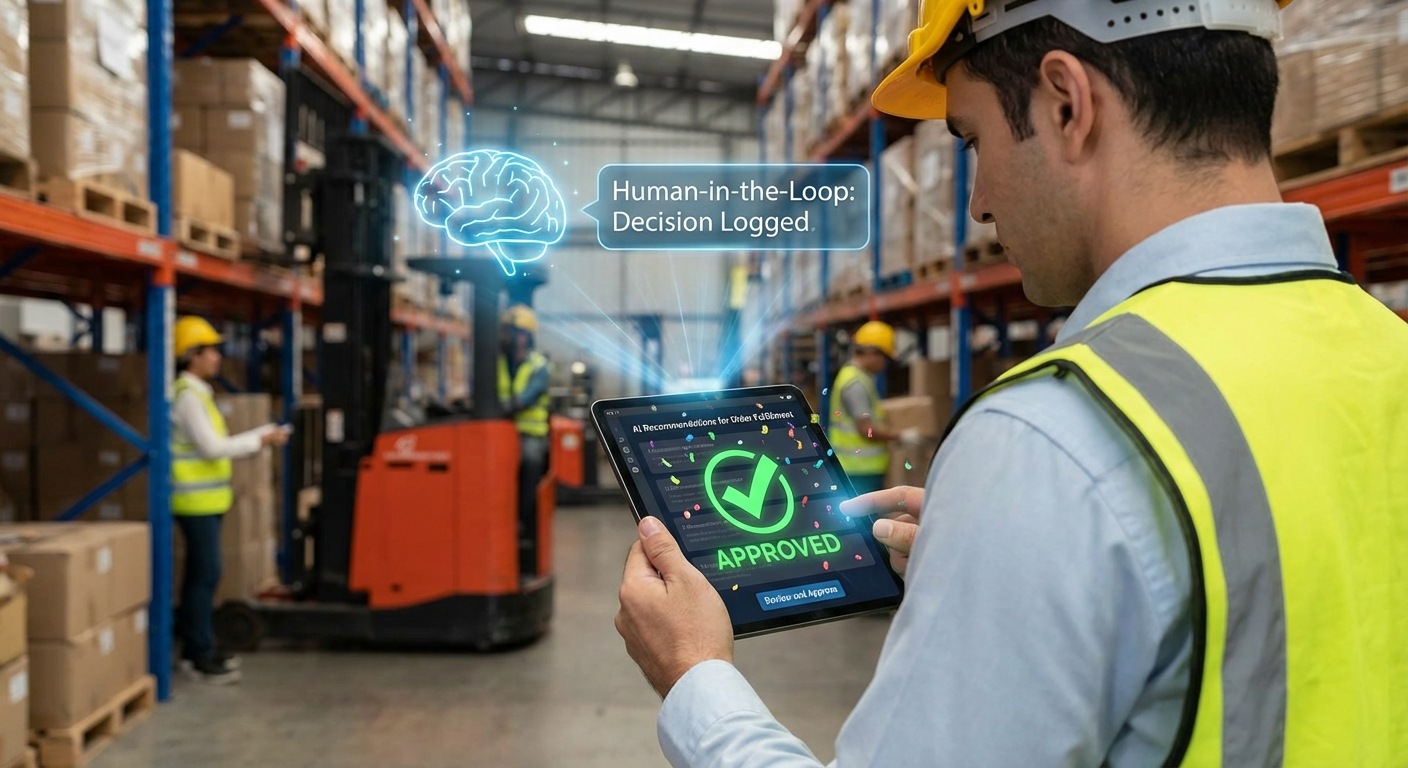
- Introduce a closed feedback loop. Begin by sending a controlled number of AI-suggested actions into operations with human approval.
- Expand use cases and cadence. Move from batch to near real-time; add labor forecasting, anomaly detection, or replenishment triggers as capabilities stabilize.
- Enforce governance and security throughout. Maintain contracts, version control, and access policies actively.
Constraints and Trade-offs
This layered approach balances benefits and limitations:
- Latency. Streaming pipelines typically add seconds to minutes of delay. Suitable for operational planning and exception detection, but not always for sub-second control decisions.
- Added complexity. The integration layer introduces architectural overhead and requires expertise in data engineering, MLOps, and workflow orchestration.
- Data fidelity. Missing timestamps, incorrect user or location tags, or incomplete data in legacy WMS constrain AI effectiveness. Data governance must come first.
- Governance risk. Without strict contracts and monitoring, "shadow IT" arises, leading to fragile and untraceable integrations.
Overall, the trade-offs favor operational continuity and risk reduction over hastily replacing critical systems.
When Would Full Replacement Make Sense?
Certain conditions justify full rip and replace projects:
- The legacy WMS fundamentally cannot meet core stability or accuracy needs.
- Vendor support ends, security risks escalate, or infrastructure becomes unsupportable.
- Regulatory or compliance requirements mandate capabilities that legacy systems cannot deliver.
- The business has successfully externalized much decision logic and transactional state into new layers, enabling a controlled cutover.
Until those shifts occur, layering AI and integration on top of the legacy stack offers faster, lower-risk modernization.
A 90–120 Day Blueprint to Get Started
Weeks 1–3: Map contracts and data
- Identify key WMS entities (orders, inventory, tasks).
- Define canonical event schemas with keys, timestamps, and source.
- Obtain secure read-only access via APIs or exports.
Weeks 4–6: Stand up the infrastructure
- Deploy event bus and schema registry.
- Begin publishing low-frequency events from exports or APIs.
- Build raw and curated data stores.
Weeks 7–9: Prove value with a read-only use case
- For example, generate nightly slotting reports using AI models.
- Deliver via dashboards or CSV files without WMS changes.
Weeks 10–12: Close the feedback loop
- Add a feedback path for a limited number of approved changes (e.g., 10 re-slots/day through API or RPA).
- Measure results, instrument data quality, and operational impact.
Weeks 13–16: Scale carefully
- Increase cadence to near real-time as warranted.
- Add further use cases such as labor productivity forecasting.
- Enforce governance on API versioning and access controls.
Real-World Details That Matter
- Treat RPA as a controlled tool with clear rollback and exception handling, not a hack.
- Moving from point-to-point interfaces to event-driven messaging reduces coupling and accelerates future innovation.
- Contract-first API design prevents surprises during integration and upgrades.
- Observability includes data flow monitoring and schema validation, not just uptime metrics.
Where AI Delivers Fast, Durable Wins
Use cases that respect legacy constraints and bring measurable benefit:
- Slotting and replenishment. Heuristics plus machine learning reduce travel and congestion, improving throughput.
- Labor and throughput forecasting. Shift from static averages to forecast-based staffing, reducing idle time and overtime costs.
- Exception detection. Early identification of anomalies to prevent costly disruptions.
Each recommendation integrates smoothly with existing operational tools: prioritization lists, wave parameters, or manual supervisor decisions. Where APIs lack capacity, structured CSV feeds imported by the WMS serve well. Human oversight remains essential until AI proves its reliability.
Operator's View from the Floor
At All Points Logistics, with three decades in operations, we embraced the layered model without halting shipments. We started by defining simple event contracts and capturing existing signals via reports and exports. Feeding AI models from these, we first delivered recommendations for slotting and labor, then gradually closed the loop by cautiously automating select adjustments.
Our approach was not a big-bang overhaul but steady progress without disruption, a result far preferable for daily operations. The continuous incremental improvement was, and remains, the true success measure.
Conclusion: Navigating Legacy and Modernity
Modernizing warehouse operations is not a choice between old or new but a strategic coexistence. Building an event-driven, AI-enabled layer atop legacy WMS platforms respects the realities of ongoing operations while unlocking fresh capabilities.
Over time, more decision-making shifts outward into the AI layer, improving agility, responsiveness, and measurement. Yet the legacy WMS remains the foundational transaction processor and for many, will continue to be so for years to come.
If you face pressure to "get AI into the warehouse," start by exposing clean data and enforcing robust contracts. Deliver one measured capability at a time. Build infrastructure to scale. Don't tear down what works; extend it thoughtfully and let outcomes guide what comes next.
Related Reading
- AI in the Warehouse Isn't Robots — It's Better Decisions
- Turning Messy Operational Data into Decisions with AI
- The Hidden Cost of Tribal Knowledge — and How AI Captures It
- How AI Acts Like a Junior Ops Manager
This article is for informational purposes only. Carrier rates, surcharges, and policies change frequently — always verify current terms directly with the carrier for your specific situation. Have questions? Reach out to us — we're happy to help.