.png)
.png)


May 27, 2026
DHL eCommerce Breakdown: Carrier Injection, Cubic Foot Penalties, and Why Ground Isn't Worth It
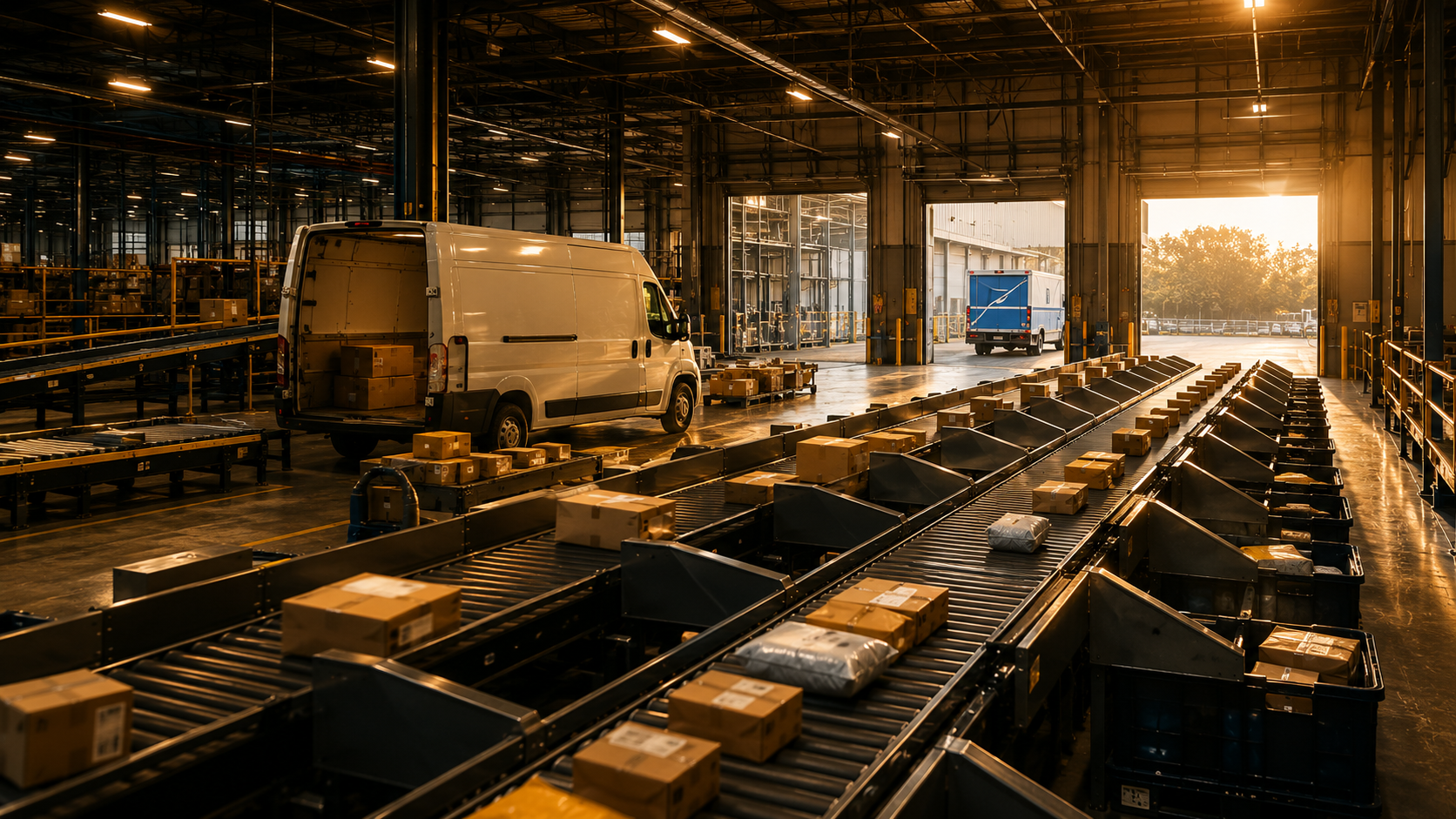
DHL eCommerce is a carrier injection service — not a traditional carrier. Your packages are picked up by independent contractors, sorted at DHL facilities, then handed off to USPS for final delivery. It's designed for lightweight eCommerce shipments, and the savings over alternatives like UPS Ground Saver or FedEx Ground Economy are often measured in cents, not dollars — especially on the Ground tier where transit times stretch to 8 business days.
Quick answer: DHL eCommerce works best for high-volume merchants shipping lightweight items (under 1 lb for SmartMail Parcel, under 25 lbs for Parcel Plus) who can tolerate longer transit windows. If you're shipping anything over a cubic foot or need reliable 2-5 day delivery, the math rarely works in DHL eCommerce's favor once you factor in oversize penalties, service issues, and the customer experience cost of slow delivery.
What DHL eCommerce Actually Is
DHL eCommerce is not DHL Express. That distinction matters. DHL Express is a premium international courier with its own planes, trucks, and delivery drivers. DHL eCommerce is a completely separate division that operates as a carrier injection network — meaning DHL handles pickup and middle-mile sorting, then injects packages into the USPS network for last-mile delivery to the customer's door.
This is the same model used by UPS SurePost (now called UPS Ground Saver), UPS Mail Innovations, and FedEx SmartPost (now FedEx Ground Economy). All of these services exist for the same reason: to exploit USPS's low last-mile delivery cost while using a private carrier's linehaul network to move packages between regions.
How the DHL eCommerce Network Works
Here's what actually happens when you ship DHL eCommerce:
Step 1: Pickup by independent contractors. Unlike UPS or FedEx, DHL eCommerce doesn't send uniformed company drivers in branded trucks. Your packages are collected by independent contractor drivers — owner-operators who pick up from multiple shippers on flexible schedules. This keeps DHL's costs low but introduces variability in pickup reliability and scan consistency.
Step 2: Sorting at DHL eCommerce facilities. Packages go to one of DHL's 19 distribution centers across the U.S. These are high-capacity sort facilities — their flagship hub near Cincinnati can process 50,000 parcels per hour using automated cross-belt sorters. Packages are sorted by destination zip code and consolidated for injection.
Step 3: Injection into USPS. Sorted packages are transported to USPS Sectional Center Facilities (SCFs) or Network Distribution Centers (NDCs), where they enter the postal stream as Parcel Select mail. From this point forward, USPS handles all delivery — your package rides alongside Priority Mail and other USPS volume, but at the lowest service priority.
Step 4: USPS last-mile delivery. Your customer's regular mail carrier delivers the package. Tracking transitions from DHL to USPS systems, which is where visibility often gets spotty. The customer sees a USPS delivery, not a DHL one.
DHL eCommerce Products
DHL eCommerce offers several domestic service tiers, all following the injection model above:
| Service | Weight Limit | Max Dimensions | Transit Time |
|---|---|---|---|
| SmartMail Parcel | Up to 1 lb | 27" x 17" x 17" | 2-8 days |
| SmartMail Parcel Plus | Up to 25 lbs | 27" x 17" x 17" | 2-8 days |
| Parcel Expedited Max | Up to 25 lbs | 27" x 17" x 17" | 1-3 days |
| Parcel Expedited | Up to 25 lbs | 27" x 17" x 17" | 2-5 days |
| Parcel Ground | Up to 25 lbs | 27" x 17" x 17" | 5-8 days |
| SmartMail Flats | Up to 1 lb | 15" x 12" x 0.75" | 3-10 days |
Notice the dimension cap: 27" x 17" x 17". That's just barely over one cubic foot (17" x 17" x 17" = 1.7 cu ft technically fits, but anything approaching or exceeding cubic foot thresholds triggers significant oversize surcharges). DHL eCommerce was designed for small, lightweight eCommerce items — think apparel, cosmetics, supplements, phone cases. The moment your box gets meaningfully larger than a cubic foot, the per-package surcharges eat your savings alive.
The Cubic Foot Penalty
This is where many shippers get burned. DHL eCommerce's pricing is optimized for small, dense packages. Once a package exceeds dimensional thresholds — particularly around the one-cubic-foot mark — oversize and dimensional weight surcharges kick in hard. The penalty isn't proportional either; it's a cliff. A box that's 12" x 12" x 12" ships at one rate, but a box that's 14" x 14" x 14" can cost significantly more despite being only marginally larger.
DHL calculates dimensional weight at L x W x H / 166 (same as UPS and FedEx), but because their base rates are already low, the DIM weight adjustment represents a much larger percentage increase. On a package where DHL eCommerce might save you $0.40 vs. USPS Ground Advantage at published rates, an oversize hit can add $2-4 in surcharges — completely negating the economics.
Bottom line: If your average package exceeds one cubic foot, DHL eCommerce Ground is not your service. Full stop.
Why DHL eCommerce Ground Is Not Worth It
Let's be direct: DHL eCommerce Parcel Ground — the cheapest tier — delivers in 5-8 business days and saves most shippers pennies per package over USPS Ground Advantage or UPS Ground Saver.
Here's the math that matters: on a typical 12 oz package shipping to Zone 5, the difference between DHL eCommerce Ground and USPS Ground Advantage is often $0.20-$0.60. For that savings, you're accepting:
An extra 2-4 days in transit. USPS Ground Advantage typically delivers in 2-5 days. DHL eCommerce Ground takes 5-8. In eCommerce, those extra days translate directly to customer complaints, "where's my order" tickets, and higher return rates.
Worse tracking visibility. The handoff between DHL and USPS creates a tracking dead zone. Packages show "tendered to delivery partner" and then go dark for 24-48 hours before USPS scans pick up. Customers see this gap and panic.
Lower service priority. Once in the USPS system, DHL eCommerce packages ride at Parcel Select priority — the lowest tier. If USPS has capacity constraints (peak season, weather events, staffing shortages), your packages sit while Priority and First-Class mail moves first.
No meaningful recourse for delays. There's no guaranteed delivery date, no money-back guarantee, and no late-delivery claims process. If a package takes 12 days instead of 8, that's within the realm of "normal" for this service.
When you're saving $0.30 per package and shipping 1,000 packages per month, that's $300/month in savings. But if even 5% of those shipments generate a customer service contact (at $5-8 per contact), you've lost $250-$400 in support costs alone — before accounting for lost customers and brand damage.
How It Compares to Other Injection Services
DHL eCommerce isn't the only carrier injection option. Here's how the major players compare:
| Service | Carrier | Last Mile | Typical Transit | Best For |
|---|---|---|---|---|
| DHL eCommerce Ground | DHL | USPS | 5-8 days | Ultra-lightweight (<1 lb), non-urgent |
| UPS Ground Saver | UPS | USPS or UPS | 2-5 days | Light parcels with UPS contract |
| UPS Mail Innovations | UPS | USPS | 4-8 days | Lightweight (<1 lb), marketing mail |
| FedEx Ground Economy | FedEx | USPS | 2-7 days | Mid-weight with FedEx contract |
The key difference with DHL eCommerce is the pickup infrastructure. UPS and FedEx use their existing driver networks — the same trucks already picking up your other shipments can grab SurePost/SmartPost packages. DHL uses independent contractors on separate routes, which means an additional pickup relationship to manage and less predictable scan timing.
UPS Ground Saver also has a significant advantage: UPS reserves the right to deliver packages directly (bypassing USPS) when it's more efficient. This happens frequently for addresses near UPS hubs, and it typically results in faster delivery. DHL eCommerce always injects into USPS — there's no bypass option.
DHL eCommerce International: DDP and Injection Points
Where DHL eCommerce does offer genuine value is international shipping for eCommerce merchants. Their Parcel International Direct service reaches 37 countries with Delivered Duty Paid (DDP) options — meaning duties and taxes are collected at checkout rather than surprising the customer at delivery.
The international injection model works differently than domestic:
U.S. origin → DHL sort facility → International linehaul → Destination country postal service. DHL handles customs clearance and duty calculation before injection into the destination country's postal network. Under DDP terms, all import fees are pre-paid, so the local postal carrier delivers without collecting anything from the recipient.
This is legitimately useful for merchants selling internationally who want to offer "no surprise fees" shipping. The transit times (5-12 business days) are reasonable for economy international service, and the DDP option eliminates the #1 cause of international order refusals: unexpected customs charges at the door.
However, be aware that DDP injection points and customs processes vary by destination country. Some routes have smoother clearance than others, and transit time variance is higher on international than domestic. Always test a route with sample shipments before committing volume.
When DHL eCommerce Actually Makes Sense
Despite the criticisms above, there are scenarios where DHL eCommerce is the right choice:
Sub-1-pound items at high volume. If you're shipping 500+ lightweight packages per day (cosmetics samples, supplements, small accessories), SmartMail Parcel rates at volume tiers can beat USPS Commercial Plus pricing. The economics only work at scale.
Non-urgent, low-value fulfillment. Subscription inserts, marketing kits, or free promotional items where delivery speed doesn't affect customer satisfaction. If the recipient doesn't care whether it arrives in 3 days or 7, the savings add up.
International DDP shipments. The Parcel International Direct product with DDP is genuinely competitive for cross-border eCommerce, particularly to Canada, UK, Germany, and Australia.
When you've maxed out USPS Commercial Plus tiers. Some very high-volume shippers find that adding DHL eCommerce as a secondary carrier gives them negotiating leverage with USPS while providing overflow capacity.
When to Avoid It
Packages over a cubic foot. The oversize penalties destroy the economics. Use UPS Ground or FedEx Ground instead.
Anything time-sensitive. If customers expect 3-5 day delivery, DHL eCommerce Ground's 5-8 day window (which frequently stretches to 10+ during peak) will generate complaints.
Premium brands. The tracking gaps, USPS last-mile handoff, and service variability undermine the delivery experience for brands that compete on customer experience.
Low volume. DHL eCommerce's rate advantages only materialize at scale. Under 50 packages per day, you're almost certainly better off with USPS Ground Advantage or negotiated UPS/FedEx rates.
The Consulting Take
We see DHL eCommerce come up frequently in carrier diversification conversations. Shippers hear "DHL" and assume they're getting the reliability of DHL Express at economy pricing. They're not. They're getting an independent contractor pickup network, a sort-and-inject middle mile, and USPS delivery at the lowest priority tier.
The Expedited and Expedited Max tiers can work — they offer reasonable 1-5 day delivery at competitive rates for lightweight items. But Ground? The per-package savings of $0.20-$0.60 is almost never worth the 5-8 day transit time, the tracking gaps, and the customer service overhead. When the savings is measured in cents and the cost of a single customer complaint is measured in dollars, the math doesn't work.
If you're evaluating DHL eCommerce, start with a test batch on Expedited — not Ground. And always run the numbers including your actual customer service cost per contact, not just the shipping label rate.
Have questions about carrier injection services or want help evaluating whether DHL eCommerce fits your operation? Reach out — we audit these decisions for shippers every day.
This article is for informational purposes only. Carrier rates, surcharges, and policies change frequently — always verify current terms directly with the carrier for your specific situation. Have questions? Reach out to us — we're happy to help.

Meet the Author
paul@darrigoconsulting.com
I’m Paul D’Arrigo. I’ve spent my career building, fixing, and scaling operations across eCommerce, fulfillment, logistics, and SaaS businesses, from early-stage companies to multi-million-dollar operators. I’ve been on both sides of growth: as a founder, an operator, and a fractional COO brought in when things get complex and execution starts to break