.png)
.png)


May 28, 2026
Why Every Operations Leader Should Know Their Cost — and Revenue — Per Square Foot
If you run an operation with a physical footprint — a warehouse, a distribution center, a manufacturing floor — your building is almost certainly your single largest fixed cost. And unlike most costs, it comes with a hard constraint: you have a finite number of square feet, and you can't get more without a step change.
You can't add 10% more warehouse. You can't flex up gradually when volume spikes. You either operate within the walls you have, or you sign a lease on an entirely new facility — with all the capital, lead time, and operational complexity that comes with it.
That's why every operations leader should understand two numbers cold: what each square foot costs them, and what each square foot earns them.
The step function problem
Most business costs scale somewhat linearly. Need more labor? Hire incrementally. Need more packaging materials? Order a bigger batch. Need more software licenses? Add seats. These are variable costs, or at least costs that can be adjusted in small increments.
Space doesn't work that way.
Your building is a block of capacity. You're either at 60% utilization or 95% utilization, and the cost is roughly the same either way. When you hit the ceiling, there's no dial to turn — you need an entirely new facility. That decision takes months of planning, hundreds of thousands (or millions) in upfront cost, and carries risk. You're betting on future volume before you have it.
This is the step function problem: your biggest fixed cost can only change in large, discontinuous jumps. Everything between those jumps is about how well you use what you already have.
Know your cost per square foot
When people talk about facility costs, they usually think about rent or mortgage. But that's only the starting point. Your true cost per square foot includes every expense tied to maintaining and operating the space:
| Cost category | What it includes |
|---|---|
| Occupancy | Rent or mortgage, property taxes, insurance, CAM charges |
| Utilities | Electricity, gas, water, HVAC, waste removal |
| Maintenance | Repairs, janitorial, grounds, equipment maintenance tied to the space |
| Infrastructure | Racking, shelving, conveyor systems, dock equipment — amortized over their useful life |
| Facility labor | Facilities manager, security staff, dock supervisors — the minimum headcount the building requires regardless of volume |
| Compliance and safety | Fire suppression, security systems, regulatory requirements |
Add it all up, divide by your usable square footage, and you get the real number. Most operations leaders know their rent per square foot. Far fewer know their fully loaded cost per square foot — and the gap between those two numbers is often 40-60% higher than they expect. One category that's easy to overlook is facility labor: the people your building needs just to exist. A facilities manager, a security guard, a dock supervisor — these roles don't scale with volume, they scale with the building. Whether you ship ten pallets or ten thousand, those salaries are part of what each square foot costs you.
This is the baseline. Every square foot in your building costs you this much whether it's productive or not. The empty corner where returns pile up? It costs the same as your highest-throughput pick zone. The staging area that sits idle three days a week? Same rate.
Know your revenue per square foot
The cost side tells you what you're spending. The revenue side tells you what you're getting for it.
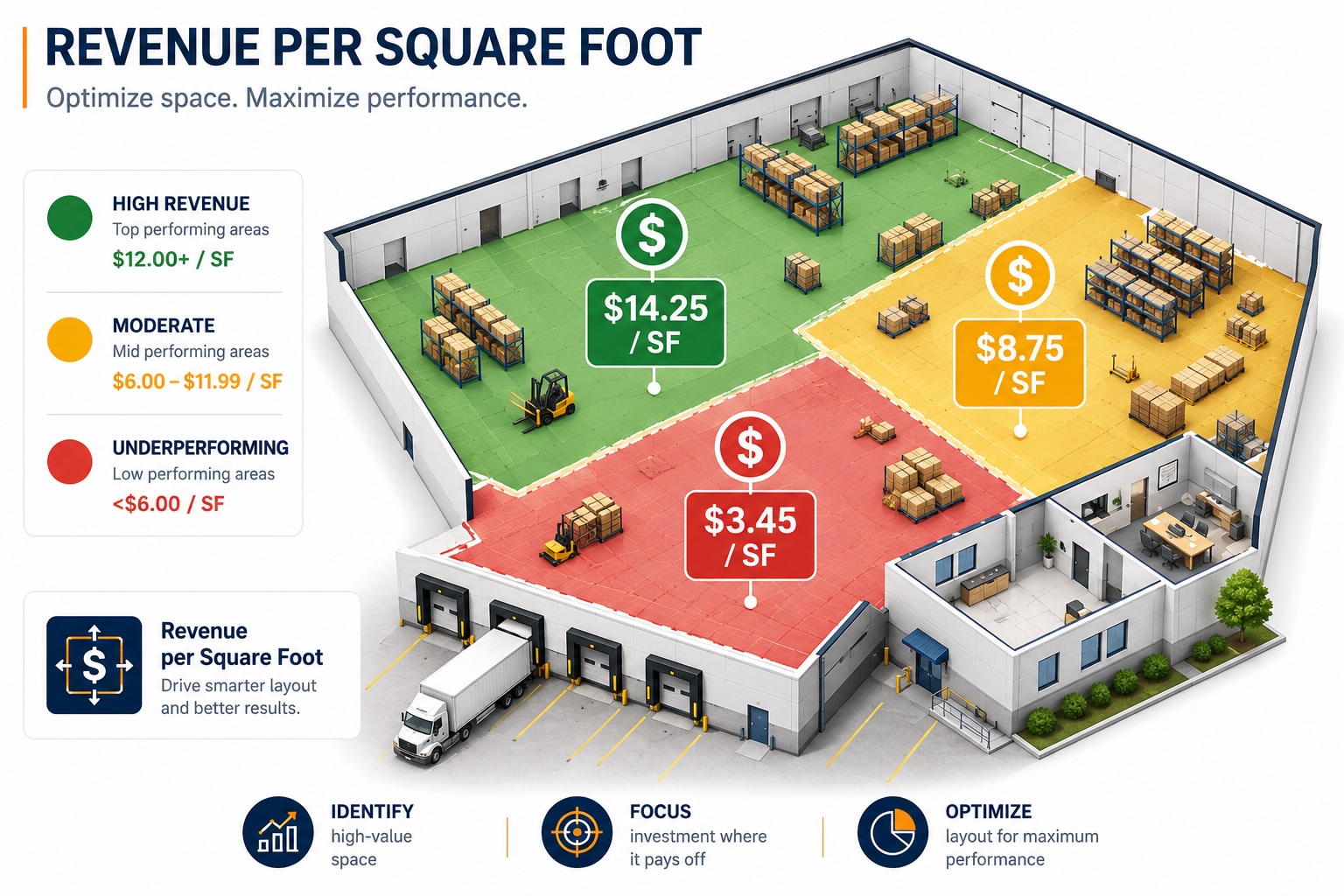
Revenue per square foot is straightforward in concept: take your total revenue and divide by your operational square footage. But the number becomes far more useful when you break it down by zone, by product line, or by function.
That's when you start seeing things like:
- A product line occupying 30% of your floor space but generating 12% of revenue
- A pick area producing three times the revenue per square foot of the zone next to it
- Seasonal inventory consuming premium space for months before and after its selling window
- Dead stock quietly renting your most expensive real estate at zero return
None of these problems are visible in a standard P&L. They only emerge when you overlay financial performance onto your physical footprint.
The ratio is the insight
Individually, cost per square foot and revenue per square foot are useful reference numbers. Together, they form a ratio that reveals the health of your operation.
If your fully loaded cost is $14 per square foot per month and your revenue per square foot is $85, you have a healthy margin of space productivity. If that revenue number is $22, you have a problem — even if your overall P&L looks fine because other parts of the business are compensating.
The ratio also changes the way you evaluate decisions:
| Decision | Without $/SF lens | With $/SF lens |
|---|---|---|
| Adding a new product line | "Does the margin work?" | "Does the margin work given the square footage it requires, and what it displaces?" |
| Holding safety stock | "We need buffer for demand variability" | "Each pallet of safety stock costs us $X/month in space — is it worth more than the stockout risk?" |
| Expanding to a second facility | "We're running out of room" | "Are we truly out of productive capacity, or are we storing low-value inventory that should be liquidated or moved offsite?" |
| Investing in vertical storage | "Racking is expensive" | "Vertical storage effectively doubles our usable SF at a fraction of the cost of a new lease" |
| Accepting a new customer | "Does the contract margin look good?" | "Will this customer's inventory profile generate enough revenue per SF, or will they consume space that higher-value clients need?" |
Why this gets missed
Most companies track their facility costs in aggregate. The rent line shows up in the P&L, the utilities get bucketed under overhead, and the building is treated as a sunk cost that everyone just works around.
The problem with treating space as a sunk cost is that it removes it from decision-making. If the building is "already paid for," then there's no cost to storing slow-moving inventory, no penalty for inefficient layouts, and no urgency to optimize how space is allocated.
But it's not free. It's fixed — and finite. Those are very different things.
A fixed cost that's also finite is the most strategically important cost in the business, because every decision about what goes into that space is also a decision about what doesn't. Every pallet of dead stock is a pallet of fast-moving product that has to go somewhere else — or doesn't get ordered at all.
The expansion trap
The step function nature of facility costs creates a specific trap that catches growing companies: they delay the expansion decision until they're desperate, then overshoot because the minimum viable next step is a whole new building.
Here's how it typically plays out. A company grows steadily and hits 90% space utilization. Operations start to strain — receiving backs up, pick paths get congested, staging areas overflow into aisles. The team compensates with workarounds: off-site overflow storage, weekend shifts, creative stacking. These workarounds carry hidden costs — extra transportation, damaged product, reduced throughput — but they're invisible in the P&L because they're spread across a dozen line items.
Meanwhile, the cost of a new facility is very visible: a large, concentrated capital commitment that shows up as a single, alarming number. So leadership delays.
By the time the decision is made, the company has been bleeding efficiency for months. And because facility decisions have long lead times — six to eighteen months from lease signing to operational readiness — there's a painful gap between deciding and having capacity.
Companies that track revenue per square foot over time see this coming. When the number starts declining — when you're adding revenue slower than you're consuming space — that's the early warning signal. It doesn't mean you expand immediately, but it means you start planning, because the step function doesn't wait for you to be ready.
Practical application
You don't need a sophisticated system to start using this framework. Begin with three steps:
First, calculate your fully loaded cost per square foot. Take every facility-related expense for the last 12 months — rent, utilities, maintenance, insurance, equipment depreciation, property taxes, and fixed facility labor like your facilities manager or security staff — and divide by your usable square footage. Not your total lease footprint; your usable operational area after you subtract offices, restrooms, and mechanical spaces. This is your baseline.
Second, map revenue to zones. You don't need to get granular on day one. Start with major areas: primary storage, pick zones, receiving, shipping, value-add areas, and returns. Allocate revenue based on which products move through which zones. Even rough allocations will reveal imbalances.
Third, review monthly. The value of these metrics isn't in any single snapshot — it's in the trend. Is your revenue per square foot climbing or flat? Is your cost per square foot creeping up faster than revenue? Are certain zones consistently underperforming? The trend tells you where you're headed before you get there.
It's not the only metric, but it might be the most honest one
Revenue per square foot doesn't capture everything. It doesn't account for labor efficiency, service quality, or customer satisfaction. It's not a substitute for a balanced scorecard.
But it does something that most operational metrics don't: it forces you to confront the physical reality of your business. You have a fixed amount of space. That space costs money whether you use it well or not. And when you need more, you can't get a little more — you have to get a lot more, all at once.
Every operations leader deals with this constraint, but not every operations leader manages to it. The ones who do tend to make better decisions about inventory, product mix, layout, and expansion timing — not because they have better instincts, but because they have a clearer picture of what their space is actually doing for them.
Your building is probably your most expensive asset and your most constrained resource. It deserves to be measured like one.

Meet the Author
paul@darrigoconsulting.com
I’m Paul D’Arrigo. I’ve spent my career building, fixing, and scaling operations across eCommerce, fulfillment, logistics, and SaaS businesses, from early-stage companies to multi-million-dollar operators. I’ve been on both sides of growth: as a founder, an operator, and a fractional COO brought in when things get complex and execution starts to break